Google AI Overviews: What It Means for SEO
Google AI Overviews are shifting search from a list of links toward AI-generated answers. That means businesses aren’t only competing for rankings anymore. They’re competing to become trusted sources behind those answers.
For UAE businesses, this makes the relationship between SEO and Generative Engine Optimization (GEO) increasingly important. Google used to give you ten blue links. Now, it can give you the answer. That’s great for searchers. For businesses that rely on Google, it’s a different story.
If Google can answer a question before someone visits your website, what happens to your organic traffic? The answer isn’t to abandon SEO. It’s to rethink what search visibility means.
What Are Google AI Overviews?
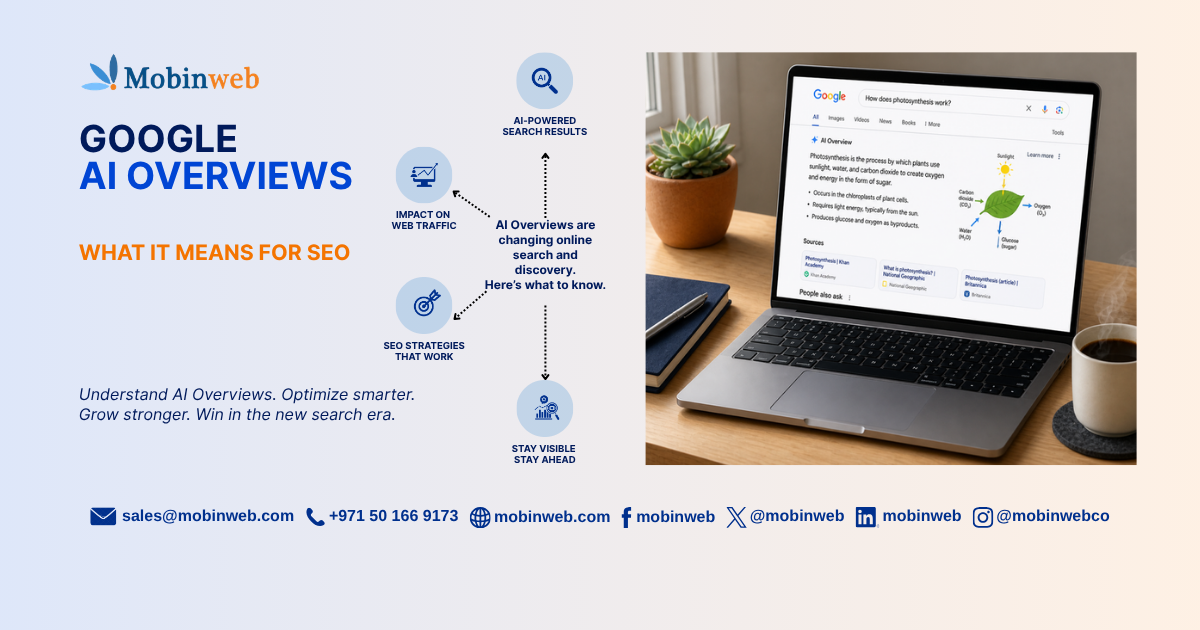
Google AI Overviews are AI-generated summaries that can appear in search results when Google determines that an AI-powered answer can help with a query.
Instead of opening several pages and piecing together information, users can receive a summary with links to supporting sources.
That changes your website’s role. Traditional SEO asks: How do I rank higher? AI-powered search adds another question: Can my content become a trusted source for the answer? That’s where things get interesting.
How AI Overviews Are Changing SEO
AI Overviews are changing SEO because users can now get a direct answer before they see traditional organic results. This shifts the focus from rankings and clicks alone to visibility, citations, authority, and inclusion in the information Google uses to build its answers.
1. Rankings Aren’t the Whole Story
Ranking #1 is still valuable. But it no longer tells the entire story of your search visibility.
A business can now think about visibility across:
- Traditional organic results
- Search features
- Brand visibility
- AI-powered answers
- Website engagement
- Leads and conversions
Instead of asking only “What position do we rank for?”, ask: “How visible are we throughout the customer’s search journey?” That’s a much more useful SEO question.
2. Generic Content Has Less to Offer
The internet already has thousands of articles explaining the same topics. Simply rewriting what’s already available doesn’t give users much reason to choose your page.
Google’s guidance around AI search emphasizes useful, original, and non-commodity content. For businesses, that means adding something competitors don’t:
- Original research
- First-hand experience
- Expert insights
- UAE-specific knowledge
- Practical examples
- Data and comparisons
Don’t just create another page. Create a reason to reference yours.
3. Search Is Becoming More Conversational
A customer might start with: “ERP software UAE“
Then ask: “Best ERP for SMEs in Dubai?” after which he asks: “How much does ERP implementation cost?” Then: “Can ERP integrate with CRM?.”
Those aren’t four separate topics. They’re one buying journey. Your content should therefore answer the questions surrounding a customer’s problem, not produce dozens of pages targeting minor keyword variations.
This is where topical authority becomes more valuable.
SEO vs GEO: What’s the Difference?
GEO, or Generative Engine Optimization, is often described as the “new SEO.”
It isn’t. GEO works alongside SEO.
| SEO | GEO |
|---|---|
| Improves organic visibility | Expands visibility into AI-powered search |
| Targets search intent | Addresses questions, topics, and entities |
| Optimises pages | Builds topical authority |
| Focuses on rankings and traffic | Looks at visibility and business outcomes |
| Builds website authority | Demonstrates expertise and credibility |
The strongest strategy isn’t SEO vs GEO. It’s: SEO + GEO + useful content + a strong website.
Your technical SEO helps search engines access your information. Your content gives them something useful to understand. Your expertise gives people and search systems a reason to trust it.
What Should UAE Businesses Do Now?
AI search isn’t something businesses need to panic about. They need to prepare for it.
Build content around problems, not just keywords
Instead of targeting: “CRM UAE, think: “How can a UAE SME manage customer relationships more effectively?”. That question can lead to a much more useful piece of content.
Turn your website into a knowledge hub
Your blog shouldn’t exist separately from your business. A stronger journey looks like:
Blog → Service → Solution → Case Study → Contact
Someone discovers your content, explores your expertise, sees what you offer, and knows the next step. That’s how SEO can support actual business growth.
Make your expertise obvious
Your website should clearly explain:
- Who you are
- What you offer
- Who you serve
- Where you operate
- What problems you solve
- Why customers should trust you
For a UAE technology business, that could include expertise in ERP, CRM, digital transformation, business automation, website development, and digital marketing.
Make your content genuinely useful
Don’t try to make content “AI-friendly.” Make it worth citing. Always remember that original insights, local expertise, practical examples, and real experience are much harder to replace with another generic article.
Update what you already have
You don’t necessarily need another 100 blog posts. You may need to improve the 30 you already have. Ask:
- Is the information still accurate?
- Does it answer the question quickly?
- Does it offer anything original?
- Are important questions missing?
- Are internal links useful?
- Does the reader know what to do next?
Quality should come before volume.
Will AI Overviews Kill Website Traffic?
Not necessarily. It depends on search intent. Someone searching: “What is ERP?” may only need a quick explanation.
But someone searching: “Best ERP solution for an SME in Dubai” may want to compare providers, understand the features, evaluate the implementation, check pricing, and speak with a company.
That’s where your website becomes harder to replace.
Google can provide an answer. Your website can provide the expertise, evidence, and experience behind a decision.
And that’s much more valuable than a simple definition. Google also recommends looking beyond clicks to consider engagement and business outcomes, such as leads and conversions.
How Should Businesses Measure SEO Now?
Rankings still matter, but they shouldn’t be the only KPI. Track four areas:
Search visibility
- Impressions
- Clicks
- CTR
- Rankings
- Branded and non-branded visibility
Engagement
- Engaged sessions
- Important page visits
- Returning visitors
Business results
- Leads
- Enquiries
- Calls
- Demo requests
- Sales
AI visibility
Google has begun rolling out generative AI performance reporting in Search Console, giving some websites more insight into visibility across AI-powered search experiences such as AI Overviews and AI Mode.
The SEO dashboard is therefore becoming broader:
Rankings + Visibility + Engagement + AI Visibility + Conversions
The New Reality of SEO
Search has evolved:
Keywords → Search Intent → Topics → Entities → Answers → AI Search
But SEO isn’t disappearing.
It’s expanding.
The businesses that adapt won’t necessarily be the ones publishing the most content. They’ll be the ones creating better answers, demonstrating genuine expertise, and building websites that both search engines and customers can trust.
For UAE businesses, that means treating SEO, GEO, content, and digital experience as parts of the same strategy.
Because the goal isn’t simply:
Rank #1.
It’s: Become the source Google can trust, and the business customers choose.
FAQs
What are Google AI Overviews?
Google AI Overviews are AI-generated summaries that can appear in Google Search to help answer a user’s query. They can draw on information from multiple sources and provide links for further exploration.
Are AI Overviews replacing SEO?
No. Google’s existing SEO fundamentals, including technical accessibility, indexing, and useful content, remain important for AI-powered search experiences.
Will AI Overviews reduce organic traffic?
They may affect clicks differently depending on the query. Simple informational searches may be answered directly, while commercial and complex searches can still create strong reasons to visit a website.
What is GEO?
Generative Engine Optimization (GEO) refers to strategies that aim to improve a business’s visibility within AI-powered search and generative answers. It complements traditional SEO.
How can businesses prepare for AI Overviews?
Focus on original, useful content, genuine expertise, topical authority, strong technical SEO, clear business information, and content that answers real customer questions.
Should businesses create separate content for AI search?
Not simply to target AI systems. The better approach is to create genuinely valuable content that works for people while making it easy for search engines and AI-powered systems to access and understand.