What Is Generative Engine Optimization (GEO)
The way people search online is changing. Instead of scrolling through ten blue links, users are increasingly asking AI assistants direct questions and receiving summarized answers in seconds. This shift is giving rise to a new discipline known as Generative Engine Optimization (GEO), the practice of optimizing content so AI-powered search engines can discover, understand, trust, and cite your business.
By the end of the article, readers should understand:
- What GEO is
- Why AI search is changing digital marketing
- How GEO differs from SEO
- Why businesses should care
- Practical steps they can implement today
- Why Mobinweb is the right partner
Let’s discuss what GEO is, how it works, how it differs from traditional SEO, and how your business can prepare for the future of search.
What Is Generative Engine Optimization (GEO)?
For over two decades, businesses have relied on Search Engine Optimization (SEO) to improve their visibility on search engines like Google and Bing. The goal has always been straightforward: rank higher in search results so more people visit your website.
Today, however, the way people search for information is evolving. Generative Engine Optimization is the practice of creating and optimizing digital content so that AI-powered search engines and large language models (LLMs) can easily discover, understand, and reference your website when generating answers to users’ questions.
Unlike traditional SEO, which primarily focuses on improving rankings in search engine results pages (SERPs), GEO focuses on increasing your brand’s visibility in AI-generated responses. The objective is not simply to appear on the first page of search results, but to become one of the trusted sources that AI systems use to answer questions.
From Search Rankings to AI Recommendations
Think about how people search today. A few years ago, someone looking for a business software solution might have typed:
ERP UAE
Today, they’re far more likely to ask:
“What’s the best ERP software for manufacturing companies in the UAE?”
Or:
“Which CRM integrates well with accounting software for small businesses in Dubai?”
These questions are more conversational, more specific, and more aligned with how people naturally communicate.
Instead of matching a few keywords, AI systems interpret the user’s intent, analyze the question’s context, and generate a complete response based on information they consider accurate and trustworthy.
For businesses, this means visibility is no longer determined solely by keyword rankings. It’s increasingly influenced by whether your content demonstrates expertise, provides clear answers, and is considered reliable enough to be referenced by AI.
Understanding Large Language Models (LLMs)
At the heart of AI-powered search are Large Language Models (LLMs). An LLM is an artificial intelligence model trained on vast amounts of text from books, websites, research papers, documentation, and other publicly available information. Instead of searching for pages that contain a particular keyword, these models analyze language, relationships between concepts, and the overall meaning of content.
This allows them to answer complex questions in a conversational way, summarize multiple sources, compare products, and explain technical topics in easy-to-understand language.
When someone asks an AI assistant:
“What are the benefits of implementing an ERP system in the UAE?”
The model isn’t simply looking for pages containing the words “ERP” and “UAE”. It evaluates information from multiple trusted sources, identifies recurring themes, and generates a response that best addresses the user’s intent.
Why Citations Matter
A key difference between traditional search engines and AI-generated search is the importance of citations. Many AI platforms include links to the sources used in their responses, allowing users to verify information, explore topics further, and assess credibility.
For businesses, being cited by AI platforms offers several advantages:
- Builds credibility and trust with potential customers.
- Increases brand visibility beyond traditional search rankings.
- Drives qualified traffic from users actively researching solutions.
- Positions your company as an industry authority.
Rather than competing only for clicks on a search results page, businesses are now competing to become one of the trusted sources AI chooses to reference.
Semantic Understanding: Beyond Keywords
Traditional SEO often emphasized keyword placement. Businesses would identify target phrases and strategically include them throughout a page to improve rankings.
While keywords remain important, modern AI systems rely much more heavily on semantic understanding. Semantic understanding means recognizing the relationships between concepts rather than focusing on exact word matches.
For example, AI understands that these topics are closely related:
- Enterprise Resource Planning (ERP)
- Business management software
- Inventory management
- Financial reporting
- Supply chain management
- Customer Relationship Management (CRM)
Even if a page doesn’t repeat the exact phrase “ERP UAE” dozens of times, it can still be highly relevant if it comprehensively covers the broader subject and answers the user’s questions. This is why modern content should be written for people first, not algorithms.
Context Is the New Keyword
Perhaps the biggest shift introduced by GEO is moving from keyword optimization to context optimization.
Instead of asking:
“How many times should I include my target keyword?”
Businesses should ask:
- Does this content fully answer the user’s question?
- Is the information accurate and up to date?
- Does it demonstrate genuine expertise?
- Does it cover related concepts that help readers understand the topic?
- Would an AI assistant consider this a trustworthy source?
Search is becoming increasingly contextual. AI evaluates the overall quality, relevance, structure, and authority of your content, not just individual keywords.
Businesses that invest in comprehensive, well-structured, and genuinely helpful content are far more likely to earn visibility in the next generation of search.
Why Search Is Changing
Search has changed dramatically. Users once relied on short, keyword-based searches to find information. Search engines responded with a list of websites, leaving people to compare results, open multiple tabs, and piece together the answers themselves.
Today, AI is transforming that experience. Instead of searching for information, users increasingly expect AI to provide the answer for them.
From Keywords to Conversations
Consider how someone researching business software might have searched a few years ago:
- ERP UAE
- CRM Dubai
- Accounting software UAE
These short queries worked well because traditional search engines relied heavily on keyword matching. Today, users are asking much more detailed questions, such as:
“What’s the best ERP software for UAE businesses with multiple branches?”
Or:
“Which CRM integrates with accounting software and supports Arabic?”
These conversational searches provide far more context, allowing AI systems to generate responses tailored to the user’s specific needs.
For businesses, this means your content must answer real questions rather than simply target isolated keywords.
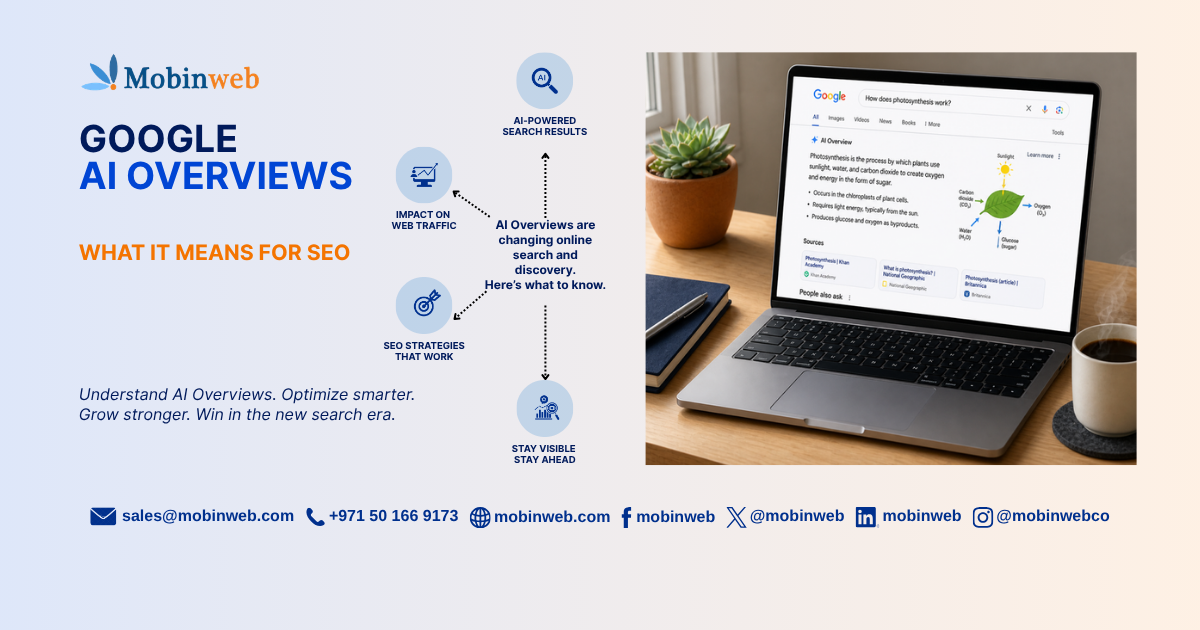
Google AI Mode
Google has begun integrating generative AI directly into the search experience through AI Mode, which can generate conversational responses to complex questions before presenting traditional search results.
Instead of showing only a list of websites, Google analyzes multiple sources, summarizes key information, and helps users explore follow-up questions without starting a new search.
For businesses, visibility increasingly depends on publishing content that is clear, comprehensive, and authoritative enough to contribute to these AI-generated responses.
ChatGPT
ChatGPT has changed how millions of people research products, compare services, and learn about unfamiliar topics.
Rather than typing several searches into Google, users can have an interactive conversation, ask follow-up questions, and receive personalized recommendations within seconds.
Whether someone is comparing ERP platforms, evaluating CRM solutions, or learning about digital transformation, ChatGPT has become a starting point for many purchasing decisions.
Microsoft Copilot
Integrated across Microsoft products such as Windows, Microsoft 365, and Bing, Microsoft Copilot combines conversational AI with web search to help users research, analyze information, and make informed decisions.
For organizations already using Microsoft technologies, Copilot is becoming an everyday productivity tool and another way businesses can gain visibility through high-quality, authoritative content.
Perplexity
Perplexity takes a research-focused approach to AI search by generating concise answers while clearly citing the sources behind them.
This emphasis on transparency encourages businesses to publish well-researched, trustworthy content that AI systems can confidently reference.
What This Means for Businesses
AI isn’t replacing search; it is reshaping how people discover information.
Traditional SEO remains an essential foundation. Businesses still need technically sound websites, strong content, and a healthy search presence. However, succeeding in the years ahead also means creating content that AI can understand, trust, and confidently recommend.
Organizations that adapt early by investing in authoritative, people-first content will be better positioned to earn visibility not only in search engine results but also in the AI-powered experiences that are becoming the new front door to the web.
GEO vs SEO: What’s the Difference?
As AI-powered search becomes more common, many business owners wonder whether Generative Engine Optimization (GEO) is replacing Search Engine Optimization (SEO).
The short answer is no.
SEO and GEO are closely connected, but they serve different purposes. Traditional SEO helps your website rank higher in search engine results, while GEO helps your content become a trusted source that AI platforms can understand, reference, and recommend.
Think of it this way:
- SEO helps people find your website.
- GEO helps AI find and understand your expertise.
Businesses that invest in both are better positioned to reach customers, whether they search on Google or ask an AI assistant for recommendations.
GEO vs SEO Comparison
| SEO (Search Engine Optimization) | GEO (Generative Engine Optimization) |
|---|---|
| Optimizes for traditional search engines | Optimizes for AI-powered search experiences |
| Focuses on improving search rankings | Focuses on AI citations, recommendations, and visibility |
| Relies heavily on keywords and search intent | Prioritizes context, entities, and semantic understanding |
| Uses backlinks as a major authority signal | Emphasizes expertise, trust, and authoritative content |
| Measures success through rankings and click-through rate (CTR) | Measures success through AI mentions, citations, and brand visibility |
While the comparison highlights their differences, GEO doesn’t replace SEO—it builds upon it.
A technically sound website, fast loading times, mobile responsiveness, proper site architecture, and optimized metadata remain essential. GEO simply extends those best practices by ensuring your content is also understandable and valuable to AI systems.
For example, a well-optimized ERP service page might rank on Google through SEO. A comprehensive guide explaining ERP implementation in the UAE could also be cited by ChatGPT or Google AI Mode when someone asks for ERP recommendations. Businesses that create both types of content are more likely to maintain visibility across multiple search experiences.
How AI Search Finds Information
Unlike traditional search engines that primarily match keywords to indexed pages, AI-powered search platforms analyze content more deeply to understand its meaning, its trustworthiness, and whether it genuinely answers the user’s question.
This process combines several technologies that work together to deliver relevant and reliable responses.
Crawling: Discovering Content
Everything begins with crawling. Search engines and AI-enabled search platforms continuously explore publicly accessible websites to discover new pages and identify updates to existing content.
If your website isn’t crawlable because of technical issues, poor site structure, or blocked pages, AI systems may never discover the valuable information you’ve published.
This is why technical SEO remains a critical foundation for GEO.
Indexing: Organizing Information
Once a page has been discovered, it is analyzed and stored in an index. During indexing, search engines don’t simply record the words on the page. They also evaluate elements such as:
- Page titles and headings
- Images and multimedia
- Internal links
- Metadata
- Page structure
- Overall content quality
A well-organized website makes it easier for both search engines and AI systems to understand what each page is about.
Semantic Understanding
As previously discussed, with semantic understanding, AI tries to understand the meaning behind the content. This allows AI to deliver more accurate, context-aware responses that align with what users are actually trying to accomplish.
Entities: Understanding People, Places, and Concepts
AI also recognizes entities- well-defined people, organizations, products, locations, and concepts- and understands how they relate to one another.
If your website discusses:
- Microsoft Dynamics 365
- Odoo ERP
- SAP Business One
- UAE Corporate Tax
- PEPPOL e-Invoicing
AI can recognize these as related business technologies and compliance topics. This helps establish your website as a credible resource within that subject area.
Using consistent terminology, clear explanations, and linking related topics together strengthens your website’s semantic relevance.
Structured Data
Structured data, also known as schema markup, provides additional context that helps search engines interpret your content more accurately.
Schema can identify:
- Articles
- Products
- FAQs
- Organizations
- Services
- Reviews
- Events
Although structured data doesn’t guarantee AI citations, it improves machine readability and helps search engines better understand your content, increasing its potential visibility across different search experiences.
Topical Authority
Perhaps the most important concept in GEO is topical authority. Instead of evaluating a single page in isolation, AI assesses whether your website demonstrates consistent expertise across an entire subject.
Imagine two companies offering SEO services. The first has one article titled “What Is SEO?”
The second has dozens of interconnected resources covering:
- SEO fundamentals
- Generative Engine Optimization
- Technical SEO
- Local SEO
- Google AI Mode
- Content marketing
- Website performance
- Structured data
- Keyword research
- Search analytics
The second website demonstrates a much deeper understanding of the topic. As a result, AI is more likely to view it as a reliable source of information.
This is why building content clusters around your core services is one of the most effective long-term GEO strategies.
Why GEO Matters for Businesses
Generative Engine Optimization isn’t simply another digital marketing trend. It reflects a broader shift in how people discover information, evaluate products, and make purchasing decisions.
As AI assistants become part of everyday search behavior, businesses that adapt early have an opportunity to strengthen their online visibility and build trust with prospective customers.
Higher Visibility Across AI Platforms
Traditional search results are no longer the only place where customers discover businesses. People now ask AI assistants for recommendations, comparisons, explanations, and buying advice.
If your content is recognized as accurate, comprehensive, and trustworthy, it is more likely to be referenced in AI-generated responses. This extends your visibility beyond conventional search rankings and introduces your brand to audiences who may never browse through multiple search results.
Build Brand Authority
Being consistently cited or referenced by AI platforms reinforces your credibility. When your content helps answer complex questions, your business becomes associated with expertise rather than advertising. Over time, this can strengthen your reputation within your industry and position your company as a trusted source of information.
Authority isn’t built overnight, but publishing consistently valuable content is one of the most effective ways to earn it.
Attract More Qualified Traffic
Not every website visitor is a potential customer. AI users often ask detailed, high-intent questions because they are actively researching solutions or preparing to make a purchasing decision.
For example:
“What’s the best ERP software for manufacturing companies in the UAE?”
or
“How can I improve my company’s visibility in AI search results?”
These users already understand their challenges and are looking for informed guidance. If your content addresses those questions, visitors to your website are more likely to engage with your business and explore your services.
Build Customer Trust
Trust is a key asset in digital marketing. AI platforms prioritize factual, well-structured, and useful content. Publishing educational resources constantly, practical guides, and expert insights, businesses demonstrate their knowledge before a sales conversation even begins.
This helps potential clients feel more confident in your expertise and can shorten the decision-making process.
Gain a Competitive Advantage
Many businesses are still focused exclusively on traditional SEO. While SEO remains essential, companies that begin investing in GEO today are positioning themselves for the next generation of search.
Creating comprehensive, authoritative content now allows your business to build topical authority over time, making it increasingly difficult for competitors to catch up.
Organizations that embrace both SEO and GEO aren’t simply preparing for future search trends; they’re creating a more resilient digital presence that can adapt as search technology continues to evolve.
GEO Best Practices: How to Optimize Your Business for AI Search
Understanding Generative Engine Optimization is only the first step. The real opportunity lies in applying strategies to make your business a trusted source of information for both traditional search engines and AI-powered search platforms.
Unlike conventional SEO tactics that often focused on rankings and keywords, GEO is centered on creating content that AI systems can understand, trust, and confidently recommend.
The following best practices will help your business build a stronger digital presence and prepare for the future of search.
Create Comprehensive Content That Solves Real Problems
AI search platforms aim to provide complete and reliable answers, not just links to webpages. As a result, businesses that publish comprehensive, high-quality content are more likely to be recognized as authoritative sources.
Rather than creating multiple short articles that barely scratch the surface of a topic, develop in-depth resources that answer the most common questions your audience has. Explain concepts clearly, provide practical examples, discuss benefits and challenges, and guide readers through the decision-making process.
For example, if your company provides ERP solutions, don’t stop at explaining what ERP stands for. Cover implementation strategies, costs, common mistakes, industry-specific use cases, integration options, and future trends. The more valuable and complete your content is, the more likely AI systems are to reference it.
Answer the Questions Your Customers Are Already Asking
Modern search is becoming increasingly conversational. Instead of searching for short keyword phrases, users now ask detailed questions such as:
“How do I choose the right ERP software for my business?”
“What is the difference between SEO and GEO?”
“Is AI search replacing Google?”
Your content strategy should be built around these real-world questions.
Talk to your sales team, customer support staff, and consultants. Review emails, inquiries, Google Search Console data, and frequently asked questions. Every customer question is a potential article waiting to be written.
When your content directly answers the questions your audience is asking, it naturally aligns with how AI platforms retrieve and generate information.
Structure Your Content for Humans and AI
Even the best content can lose value if it’s poorly organized. AI models analyze the structure of a page to understand how ideas relate to one another. A well-structured article also improves readability and helps visitors find the information they need quickly.
Follow a logical hierarchy using descriptive headings, short paragraphs, bullet points, comparison tables, and clearly labeled sections.
Instead of using vague headings like:
“Things to Consider”
use descriptive headings such as:
“How to Choose the Right ERP Software for Your Business”
This provides immediate context to both readers and AI systems.
Build Topical Authority, Not Just Individual Articles
Publishing one article about a topic doesn’t establish expertise. Search engines and AI systems evaluate whether your website consistently demonstrates knowledge across an entire subject area.
This is known as topical authority.
If your business specializes in digital marketing, don’t limit yourself to one article about SEO. Build a complete knowledge hub that includes:
- Generative Engine Optimization (GEO)
- Technical SEO
- Local SEO
- Content Marketing
- Website Performance
- Google AI Mode
- Structured Data
- Keyword Research
- AI Search Optimization
Each article should naturally link to related resources, creating a connected ecosystem of content. Over time, this strengthens your authority and makes it easier for AI platforms to recognize your expertise.
Implement Structured Data (Schema Markup)
Structured data helps search engines understand your website’s content more accurately. Schema markup provides additional information about your pages, such as whether they contain an article, FAQ, service, organization profile, product, or review.
While schema markup doesn’t guarantee higher visibility in AI-generated answers, it improves machine readability and increases the likelihood that your content will be interpreted correctly.
At a minimum, businesses should consider implementing:
- Organization Schema
- Article Schema
- FAQ Schema
- Service Schema
- Breadcrumb Schema
- Local Business Schema (if applicable)
Think of schema as providing extra context that helps search engines and AI better understand your business.
Strengthen Your E-E-A-T Signals
Google’s concept of E-E-A-T, Experience, Expertise, Authoritativeness, and Trustworthiness, has become increasingly important, not only for traditional search but also for AI-powered search.
Businesses can strengthen these signals by:
- Publishing content written or reviewed by qualified professionals.
- Sharing case studies and real client experiences.
- Including author biographies and company information.
- Displaying certifications, awards, and partnerships.
- Maintaining accurate contact details and transparent business information.
Trust is becoming one of the strongest competitive advantages online. Businesses that consistently demonstrate expertise are more likely to earn visibility in both search results and AI-generated responses.
Connect Your Content Through Internal Linking
Every article on your website should contribute to a larger knowledge ecosystem.
Internal links help search engines understand the relationships between topics while encouraging visitors to continue exploring your website.
For example, an article about Generative Engine Optimization can naturally link to:
- SEO vs GEO
- Technical SEO Guide
- Website Speed Optimization
- Content Marketing Strategy
- Structured Data Guide
This improves user experience, strengthens topical authority, and distributes authority across your website.
Keep Your Content Accurate and Up to Date
Technology evolves quickly, particularly in areas such as artificial intelligence, digital marketing, and search.
An article that was accurate twelve months ago may already contain outdated recommendations.
Review cornerstone articles regularly to update:
- Statistics
- Screenshots
- Industry trends
- Best practices
- Product information
- AI platform capabilities
Fresh, accurate content builds trust with readers and demonstrates that your business remains active and informed.
Publish Original Research and Unique Insights
AI platforms don’t simply value information, they value information that offers something different. One of the most effective ways to stand out is to publish original content based on your expertise.
Examples include:
- Industry reports
- Customer surveys
- Case studies
- Performance benchmarks
- Research findings
- Expert commentary
Rather than repeating information that’s already available elsewhere, contribute something meaningful to the conversation.
Original research helps establish your business as an authority while giving AI platforms a compelling reason to reference your content.
Optimize for Topics and Entities, Not Just Keywords
Keywords still matter, but AI search goes much further.
Modern AI systems understand relationships between concepts, brands, technologies, industries, and locations. For example, an article about ERP should naturally discuss related topics such as:
- Inventory Management
- CRM Integration
- Financial Reporting
- Supply Chain Management
- Business Automation
- Cloud Computing
This demonstrates genuine subject expertise rather than simply repeating a single keyword throughout the page.
The goal is to become the most useful resource on the topic—not the page with the highest keyword density.
Common GEO Mistakes Businesses Should Avoid
As businesses begin optimizing for AI-powered search, it’s easy to fall into habits that were once considered effective but no longer provide value.
Understanding these common mistakes can help you avoid wasted effort and build a stronger long-term strategy.
Treating GEO Like Traditional Keyword SEO
One of the biggest misconceptions is believing that AI search can be optimized by repeating keywords throughout a page.
Modern AI systems understand language context, user intent, and semantic relationships.
Instead of asking:
“How many times should I use my target keyword?”
Ask:
“Does this page genuinely answer my customer’s question?”
Quality will always outperform keyword repetition.
Publishing Generic AI-Generated Content
AI writing tools have become incredibly useful for research, brainstorming, and drafting content.
However, publishing unedited AI-generated articles without human review often results in content that feels generic, repetitive, and lacking in real expertise. Successful businesses use AI to improve efficiency, not to replace subject matter experts.
Every article should include original insights, practical experience, and expert recommendations that reflect your company’s knowledge.
Ignoring User Intent
Many businesses focus on what users search for without considering why they’re searching. Someone researching:
“What is ERP?”
has very different needs than someone asking:
“Which ERP software is best for manufacturing companies in the UAE?”
Creating content that aligns with each stage of the customer journey leads to higher engagement, greater trust, and better conversion opportunities.
Neglecting Technical SEO and Structured Data
Even outstanding content can struggle if search engines can’t properly crawl or interpret your website. Common technical issues include:
- Slow page speed
- Poor mobile responsiveness
- Missing schema markup
- Broken internal links
- Weak site architecture
GEO works best when it’s built on a strong technical SEO foundation.
Publishing Without a Content Strategy
Many businesses publish articles sporadically without a clear topical focus. As a result, their content lacks consistency and authority.
Instead of writing about unrelated subjects, build content clusters around your core services and areas of expertise.
This strengthens topical authority and helps both users and AI understand what your business is known for.
The Future of GEO
Artificial intelligence is transforming how people discover information, evaluate products, and make purchasing decisions. Generative Engine Optimization is still in its early stages, but several trends are already shaping the future of digital marketing.
AI Assistants Will Become the New Front Door to the Internet
AI assistants are changing how users interact with information. Rather than browsing dozens of websites, people increasingly expect direct, conversational answers.
Businesses that establish themselves as trusted sources today will be better positioned as these platforms continue to grow.
Search Will Become More Conversational
Users are moving away from short keyword searches toward natural language questions.
Instead of searching:
ERP UAE
People are asking:
What’s the best ERP software for a growing manufacturing company in the UAE?
This shift requires businesses to create content that reflects real conversations rather than isolated keywords.
Multimodal Search Will Continue to Expand
The future of search isn’t limited to text. AI platforms are becoming increasingly capable of understanding images, videos, documents, voice searches, and visual content.
Businesses should begin thinking beyond written articles by creating informative videos, infographics, diagrams, and visual guides that support their expertise.
AI Agents Will Influence Buying Decisions
The next generation of AI won’t simply answer questions, it will help users complete tasks. Future AI agents may compare software solutions, shortlist vendors, request quotations, schedule consultations, and even assist with purchasing decisions.
Businesses with strong digital authority and well-structured information will have a significant advantage in this environment.
Personalized Recommendations Will Become More Accurate
AI systems are becoming increasingly personalized. Future recommendations may consider factors such as:
- Industry
- Company size
- Business goals
- Geographic location
- Previous interactions
- User preferences
This makes high-quality, relevant, and authoritative content more valuable than ever. Businesses that consistently publish useful information will be better positioned to earn personalized recommendations across AI-powered platforms.
Conclusion
Search is evolving faster than at any point in the last two decades. While traditional SEO remains an essential part of every digital marketing strategy, businesses can no longer rely solely on rankings to build online visibility. AI-powered search is changing how people discover brands, evaluate solutions, and make purchasing decisions.
Generative Engine Optimization represents the next stage of digital visibility.
Businesses that invest today in comprehensive content, topical authority, technical excellence, and genuine expertise won’t simply keep pace with these changes, they’ll be well positioned to lead them.
The question is no longer whether AI will influence search. The question is whether your business will be ready when your potential customers begin asking AI for recommendations instead of browsing search results.
The organizations that adapt early will have the opportunity to build stronger authority, earn greater trust, and become the businesses that both people and AI choose to recommend.
Ready to Future-Proof Your Digital Presence?
Whether you’re looking to strengthen your SEO strategy, improve your visibility in AI-powered search, or build a content ecosystem that positions your business as an industry authority, the right strategy starts with understanding how search is evolving.
At Mobinweb, we help businesses navigate this new landscape through strategic SEO, Generative Engine Optimization (GEO), high-quality content, website optimization, and AI-ready digital marketing solutions.
If you’re ready to prepare your business for the future of search, let’s start the conversation.