UAE e-Invoicing Guide for SMEs: Deadlines & Rules (2026–2027)
Last updated: 16 October 2026
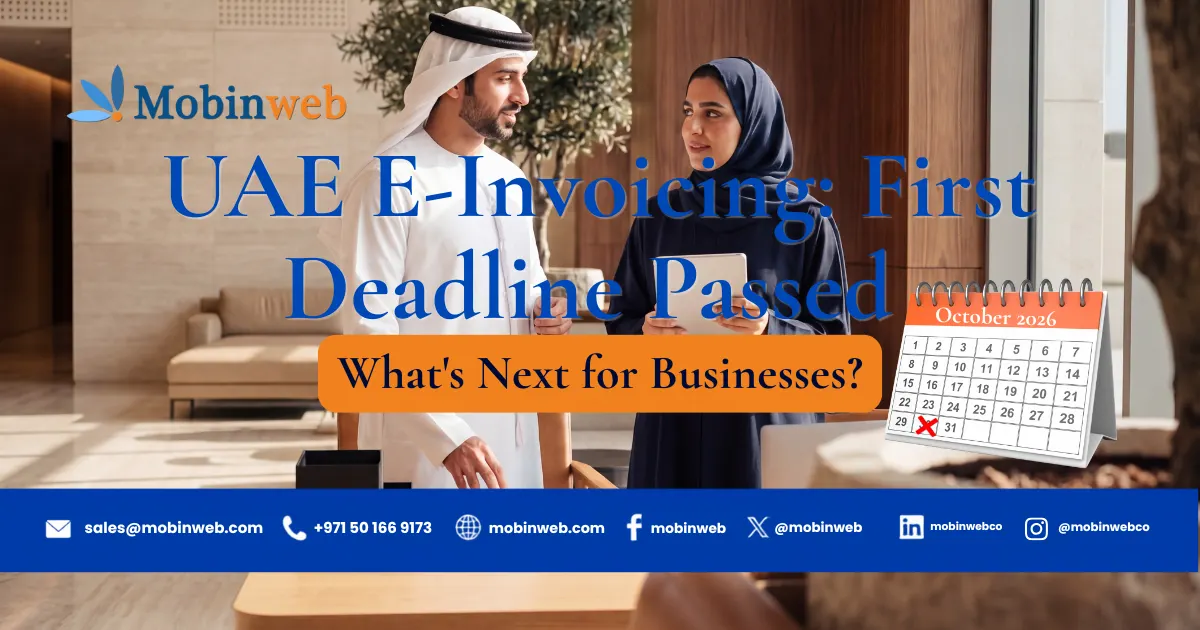
The UAE is introducing a new electronic invoicing system that will change how businesses send, receive, and report invoices.
If you run a small or medium-sized business (SME), you may be wondering what this means for your company, whether your current accounting software is enough, and when you need to comply.
The good news is that you can prepare step by step. This guide explains UAE e-Invoicing in simple terms, including the latest implementation deadlines, how to choose an Accredited Service Provider (ASP), and what your business should do next.
Quick Answer: What Do UAE Businesses Need to Know?
UAE Businesses Need to Know?
- E-Invoicing will be introduced in phases. The deadline depends on your business category and annual revenue.
- AED 50 million or more in annual revenue: Appoint an ASP by 30 October 2026 and implement e-Invoicing by 1 January 2027.
- Below AED 50 million in annual revenue: Appoint an ASP by 31 March 2027 and implement e-Invoicing by 1 July 2027.
- In-scope government entities: Appoint an ASP by 31 March 2027 and implement e-Invoicing by 1 October 2027.
- A PDF invoice is not an e-Invoice under the UAE system. The required invoice must use a structured digital format that software can read automatically.
- Your accounting software may need an upgrade or integration. Simply creating invoices digitally does not guarantee compliance.
These dates are based on the UAE Ministry of Finance’s published implementation framework. Businesses should confirm their specific obligations and any applicable exclusions through the official guidance.
Download this Mobinweb Business Checklist to see if your business is ready for this shift.
What Is UAE e-Invoicing?
UAE e-Invoicing is a system for creating, sending, receiving, and reporting invoices electronically in a standard format. Instead of emailing invoices as PDF attachments, businesses will exchange invoice information through approved digital systems.
The buyer’s and seller’s business software can then process the invoice data automatically and report it through the e-Invoicing system to the Federal Tax Authority (FTA).
Is a PDF Invoice Considered an e-Invoice?
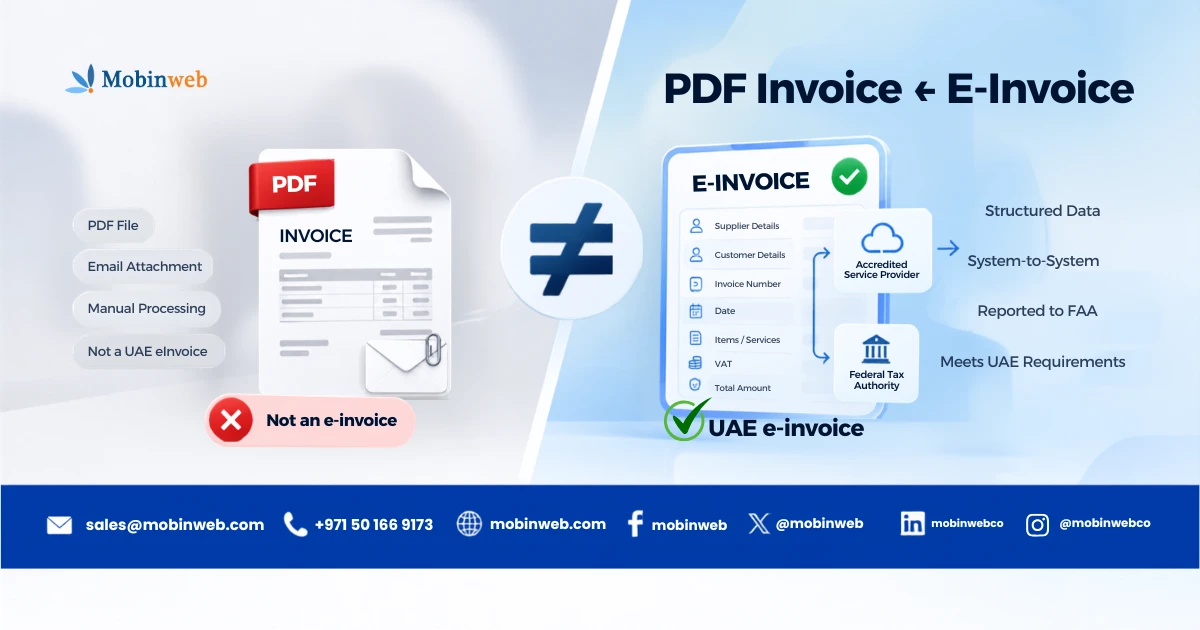
No. A PDF invoice, scanned document, Word file, or image is not a structured e-Invoice under the UAE framework.
Here is the difference:
| Traditional invoice | Structured e-Invoice |
|---|---|
| Sent as a PDF or paper document | Exchanged in a structured digital format |
| Often requires manual data entry | Can be processed automatically by software |
| Information may need to be entered again | Data can move between connected systems |
| Errors may occur during manual entry | Automated checks can help reduce errors |
Example: Today, your business might email a PDF invoice to a customer. The customer then downloads it and enters the details into their accounting software.
With structured e-Invoicing, the invoice data move directly between connected systems through the approved network, reducing manual work.
Who Must Comply with UAE e-Invoicing?
The UAE framework covers businesses that conduct in-scope business-to-business (B2B) and business-to-government (B2G) transactions, subject to applicable rules and exclusions.
This means the requirements are not limited to large corporations.
Depending on the scope of the rules, affected businesses may include:
- SMEs and small trading companies
- Retailers and wholesalers
- Manufacturers and distributors
- Professional service providers
- Companies selling goods or services to other businesses
- Businesses supplying government entities
The exact obligations depend on the applicable legislation, transaction type, exclusions, and implementation phase.
Does Your Business Need to Be VAT-Registered?
Do not assume that VAT registration alone determines whether your business is covered by the e-Invoicing framework. The scope of the e-Invoicing rules and the scope of VAT registration are separate questions. Review the official rules to determine whether your business and transactions are covered.
If you are unsure, speak with your tax adviser or accountant before deciding that your business is exempt.
UAE e-Invoicing Deadlines for 2026–2027
The Ministry of Finance has established a phased implementation schedule. Your business should identify the correct category and prepare according to its applicable deadlines.
| Business category | Deadline to appoint an ASP | Implementation deadline |
|---|---|---|
| Annual revenue of AED 50 million or more | 30 October 2026 | 1 January 2027 |
| Annual revenue below AED 50 million | 31 March 2027 | 1 July 2027 |
| In-scope government entities | 31 March 2027 | 1 October 2027 |
What Does This Mean for SMEs?
If your business has annual revenue below AED 50 million, your published deadlines are:
- 31 March 2027: Appoint an Accredited Service Provider.
- 1 July 2027: Implement the e-Invoicing system.
Don’t wait until March or June to start preparing. Your accounting software, customer records, supplier information, and invoice processes may need changes before implementation.
If your business has annual revenue of AED 50 million or more, the ASP appointment deadline is much sooner: 30 October 2026.
Important: The dates above are implementation deadlines, not a statement that every business transaction is already subject to mandatory e-Invoicing today. Follow the applicable phase and official guidance for your business.
What Is an Accredited Service Provider (ASP)?
An Accredited Service Provider is a provider that has completed the UAE’s required accreditation process to provide e-Invoicing services.
The ASP connects your business to the e-Invoicing network and helps transmit invoice data in the required format.
Depending on the service offered, an ASP may help with:
- Sending and receiving electronic invoices
- Checking invoice data against applicable requirements
- Connecting your accounting or ERP software to the network
- Transmitting required invoice data to the relevant system
- Supporting technical integration and testing
How Do You Choose an ASP?
Before choosing a provider, ask these questions:
- Is the provider officially accredited under the current UAE framework?
- Can it integrate with your existing accounting software or ERP?
- What are the setup, subscription, and transaction fees?
- Will it help you test your invoices before going live?
- What technical support is included?
- Can it support your expected invoice volume as your business grows?
Check the Ministry of Finance’s current list of accredited providers rather than relying only on marketing claims or an earlier pre-approval announcement.
As of October 2026, the Ministry has updated the provider accreditation framework under Ministerial Decision No. 168 of 2026. The updated process took effect on 1 October 2026 and replaced the previous pre-approval framework. This makes it particularly important to verify a provider’s current accreditation status.
What Are PEPPOL and PINT AE?
You may encounter two technical terms when researching UAE e-Invoicing: PEPPOL and PINT AE. You do not need to be a technical expert to understand the difference.
What Is PEPPOL?
PEPPOL is an international framework and network that lets different business systems securely exchange electronic documents using common standards.
Think of it as a network that helps different software systems communicate.
What Is PINT AE?
PINT AE is the UAE’s version of the PEPPOL International Invoice specification. It defines the structure and business rules needed for electronic invoices in the UAE.
In simple terms:
- PEPPOL provides the framework for exchanging electronic invoices.
- PINT AE defines the relevant invoice format and rules for the UAE.
Your business software and chosen ASP must support the applicable UAE e-Invoicing requirements.
How Does the UAE Five-Corner Model Work?
The UAE uses a five-corner model for e-Invoicing. The model connects businesses through their service providers while supporting the reporting of invoice data to the tax authority.
The five participants are:
- Seller: The business issuing the invoice.
- Seller’s ASP: The service provider transmitting the seller’s invoice.
- Buyer’s ASP: The service provider receiving the invoice for the buyer.
- Buyer: The business receiving the invoice.
- Tax authority: The FTA, which receives the required invoice data through the system.
For example, if your company sells products to another business, your ASP sends the structured invoice through the network. The buyer’s ASP receives the invoice and delivers it to the buyer’s system, while reporting the required data to the tax authority.
The five-corner model became operational during the UAE’s 2026 pilot phase. For SMEs, the practical takeaway is simple: you need a suitable service provider and compatible business systems to exchange invoices through the required network.
Does Your Existing Accounting Software Support e-Invoicing?
Not necessarily. Your software may already generate invoices, calculate VAT, and produce financial reports. However, these features don’t automatically mean it meets the UAE’s e-Invoicing requirements.
Check whether your current software can:
- Generate invoices in the required structured format
- Capture the mandatory invoice information
- Connect with an appropriately accredited ASP
- Exchange invoice data through the required network
- Handle invoice corrections and credit notes where required
- Support the relevant testing and implementation process
If your software does not support these functions, you may need an upgrade, an integration, or a different solution.
What About QBM and Other ERP Systems?
Accounting and ERP software can help manage invoices, financial records, inventory, and business operations. However, using an accounting or ERP system alone does not establish compliance with UAE e-Invoicing requirements.
For example, QBM is accounting software, not an Accredited Service Provider. Businesses using QBM should confirm the available e-Invoicing integration arrangements and the role of an appropriately accredited ASP before assuming their setup is compliant.
The same principle applies to other accounting and ERP platforms.
How Can SMEs Prepare for UAE e-Invoicing?
You do not need to change everything at once. Start with the following steps.
Step 1: Confirm Your Implementation Phase
Check your annual revenue and identify the published implementation deadline that applies to your business. Do not rely on your company size alone. Use the applicable revenue threshold and official rules.
Step 2: Review Your Current Invoicing Process
Write down how your business currently:
- Creates invoices
- Sends invoices to customers
- Receives supplier invoices
- Records VAT and transaction details
- Issues credit notes
- Stores financial records
Identify tasks that rely heavily on spreadsheets, email, or manual data entry.
Step 3: Check Your Customer and Supplier Records
Review your records for missing or incorrect information. Pay close attention to legal business names, addresses, tax registration details (where applicable), invoice numbers, and other information required by official invoice specifications. Accurate records make implementation easier.
Step 4: Speak to Your Accounting Software Provider
Ask your provider whether your current system supports UAE e-Invoicing requirements and what changes are needed. Ask specifically about structured invoice formats, PINT AE, PEPPOL connectivity, ASP integration, and testing.
Request a clear explanation of any additional fees or system upgrades.
Step 5: Select an Accredited Service Provider
Review the available providers and choose one that meets your business and technical needs. Confirm the provider’s current accreditation status and agree on the onboarding and integration plan.
Step 6: Complete the Required Registration and Onboarding
Follow the applicable registration procedures through EmaraTax and your chosen ASP. Complete the required technical connection and integration steps.
Step 7: Test Before Going Live
Before implementation, check that your business can generate, transmit, receive, and process invoices correctly. Resolve any issues with missing information, rejected invoices, incorrect VAT data, or system connections before your mandatory implementation date.
Step 8: Train Your Team
Ensure employees responsible for invoicing, accounts payable, accounts receivable, and finance understand the new process. Document who handles invoice errors, corrections, rejected invoices, and technical support requests.
What Are the Benefits of e-Invoicing for SMEs?
Although e-Invoicing introduces new compliance requirements, it can also improve everyday business operations.
Less Manual Work
Invoice information can move between connected systems without repeated data entry.
Fewer Errors
Automated validation can help identify missing information and incorrect data before invoices are processed.
Faster Processing
Invoices can move through connected systems more efficiently, reducing delays associated with manual handling.
Better Financial Records
Structured invoice data can make it easier to track sales, purchases, outstanding invoices, and VAT-related information.
More Efficient Business Operations
Businesses that improve their invoicing processes may spend less time correcting errors and managing paperwork. The actual benefits depend on your invoice volume, software, workflows, and implementation quality.
Common Questions About UAE e-Invoicing
Is UAE e-Invoicing mandatory for SMEs?
SMEs are not automatically exempt because they are small businesses. In-scope businesses must follow the applicable requirements and implementation phase. Businesses with annual revenue below AED 50 million have a published ASP appointment deadline of 31 March 2027 and an implementation deadline of 1 July 2027.
What is the deadline for businesses with revenue of AED 50 million or more?
These businesses must appoint an ASP by 30 October 2026 and implement e-Invoicing by 1 January 2027, subject to the applicable rules.
Is a PDF invoice acceptable under the UAE e-Invoicing system?
No. A PDF, scanned invoice, or image is not a structured e-Invoice under the framework. Businesses must use the required structured format and exchange process.
Do I need to replace my accounting software?
Not necessarily. Your existing software may be suitable if it supports the required format and can connect to an appropriately accredited ASP. Confirm this with your software provider.
Do I need an Accredited Service Provider?
Businesses covered by the mandatory framework must appoint an ASP according to the applicable rules and deadlines. Check the current official accreditation list before selecting a provider.
What is EmaraTax used for?
EmaraTax is the UAE Federal Tax Authority’s online platform. Businesses can use the platform’s registration procedures as part of the e-Invoicing onboarding process.
What happens if my business is not ready by the deadline?
Do not assume that an unprepared system will receive an automatic extension. Review the applicable legal requirements, seek professional advice if necessary, and complete the required preparations as early as possible. Applicable consequences depend on the relevant legislation and circumstances.
Where can I check the latest UAE e-Invoicing rules?
The Ministry of Finance’s official e-Invoicing portal is the primary source for current guidance, legislation, technical documents, and provider information.
Prepare Your Business for UAE e-Invoicing
UAE e-Invoicing will change how businesses exchange invoices and manage transaction data. For SMEs, the first step is identifying the right implementation deadline. Next, review your accounting software, check your business records, choose an appropriately accredited service provider, and prepare your team for the new process.
You do not need to understand every technical detail to begin. You need a clear plan, suitable software, and the right implementation support.
Starting early gives your business more time to resolve issues and meet the applicable deadline.
Need Help Preparing Your Business Systems?
At Mobinweb, we help businesses improve their financial and operational processes through ERP solutions, accounting software, workflow automation, and system integration.
Whether you need to review your existing setup, evaluate accounting software, or plan an integration, our team can help you understand your options and prepare your systems for changing business requirements.
Talk to a Mobinweb expert to discuss your business software and integration needs.