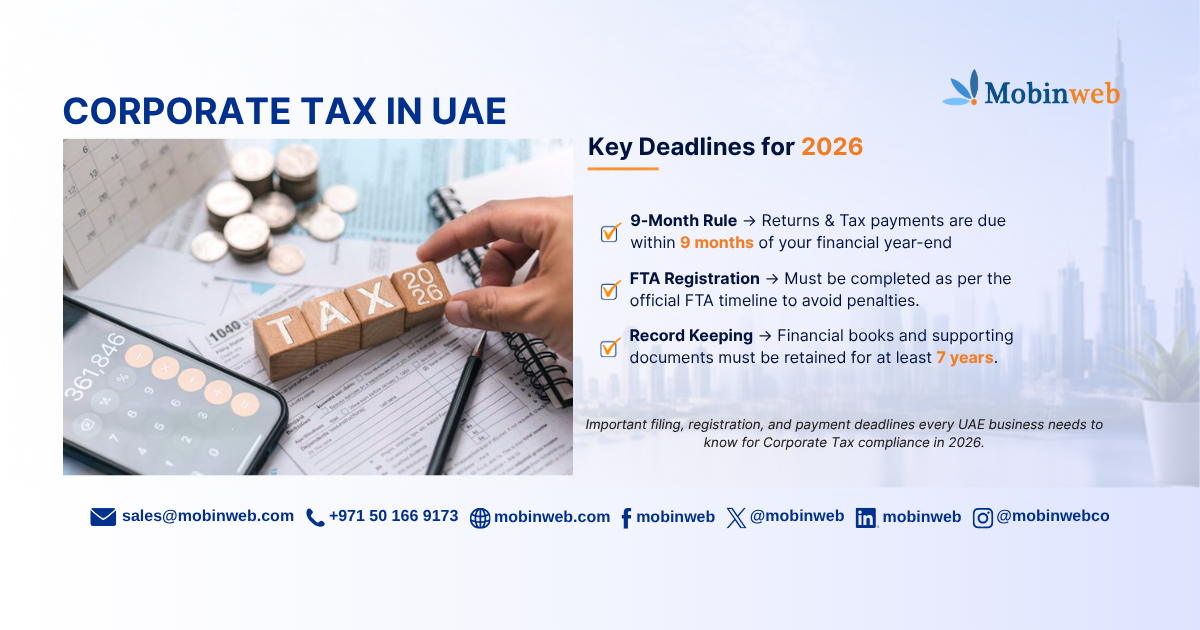
Corporate Tax in the UAE: Key Deadlines for 2026
Stay Compliant with UAE Corporate Tax Filing, Registration, and Payment Requirements
The UAE Corporate Tax regime is now fully operational, making 2026 a significant compliance year for many businesses across the country. Whether you’re a mainland company, a Free Zone business, or a foreign entity with taxable activities in the UAE, understanding your filing obligations and meeting key deadlines is essential to avoid penalties and maintain compliance.
One of the most important rules every business should remember is that Corporate Tax Returns must generally be filed within nine months after the end of the relevant tax period, and any Corporate Tax due is typically payable by the same deadline.
For many businesses operating on a calendar financial year ending 31 December 2025, this means the filing and payment deadline falls on 30 September 2026.
However, Corporate Tax compliance goes beyond simply submitting a tax return. Businesses must also register with the Federal Tax Authority (FTA), maintain accurate financial records, calculate taxable income correctly, and ensure that supporting documentation is readily available upon request.
In this guide, we’ll explain the key Corporate Tax deadlines for 2026, who needs to file, how the nine-month filing rule works, and what happens if your business misses an important deadline. We’ll also share practical tips to help your organization prepare efficiently and reduce compliance risks.
UAE Corporate Tax Deadlines at a Glance
Missing a Corporate Tax deadline can lead to unnecessary administrative penalties and additional compliance issues. Knowing your filing timeline early allows your finance team to prepare financial statements, reconcile records, and submit returns well before the deadline.
The following table summarizes the most important Corporate Tax obligations for most taxable businesses.
| Requirement | Deadline |
|---|---|
| Corporate Tax Registration | According to the FTA registration schedule |
| Corporate Tax Return Filing | Within 9 months after the end of the tax period |
| Corporate Tax Payment | Generally due on the same date as the Corporate Tax Return |
| Financial Records Retention | Maintain records for at least 7 years after the relevant tax period |
Filing Deadline Examples
The filing deadline depends on your company’s financial year-end rather than a single nationwide filing date.
| Financial Year End | Corporate Tax Filing Deadline |
|---|---|
| 31 December 2025 | 30 September 2026 |
| 31 March 2026 | 31 December 2026 |
| 30 June 2026 | 31 March 2027 |
| 30 September 2026 | 30 June 2027 |
This rolling approach means every business should calculate its own filing deadline based on its financial reporting period.
Tip: Don’t wait until the last month. Preparing your financial statements, reconciling accounts, and reviewing tax adjustments can take weeks, particularly for growing businesses or organizations operating across multiple entities.
Who Needs to File a Corporate Tax Return?
A common misconception is that only large corporations are affected by the UAE Corporate Tax regime.
In reality, filing obligations apply to a wide range of businesses operating in the UAE, although eligibility, exemptions, and taxable income may vary depending on the nature of the business.
Mainland Companies
Most companies incorporated in the UAE mainland are subject to Corporate Tax and are generally required to:
- Register for Corporate Tax
- Maintain proper accounting records
- Submit Corporate Tax Returns
- Pay any Corporate Tax due within the prescribed deadlines
The exact tax payable depends on the company’s taxable income and applicable provisions under the Corporate Tax Law.
Free Zone Businesses
Many businesses assume that operating in a Free Zone automatically exempts them from Corporate Tax.
This is not always the case.
While certain Qualifying Free Zone Persons may benefit from preferential Corporate Tax treatment if they meet the relevant conditions, filing and compliance obligations can still apply. Businesses should assess their specific circumstances and ensure they understand their reporting responsibilities under the Corporate Tax framework.
Foreign Companies
Foreign companies may also fall within the scope of UAE Corporate Tax if they have a taxable presence or permanent establishment in the UAE.
Depending on their activities, these businesses may be required to register, maintain records, and submit Corporate Tax Returns in accordance with UAE regulations.
Sole Establishments and Natural Persons
Certain natural persons conducting business activities in the UAE may also be subject to Corporate Tax if they meet the applicable thresholds and conditions set out in the law.
Business owners should review the latest guidance issued by the Ministry of Finance and the Federal Tax Authority to determine whether registration and filing obligations apply to their activities.
Exempt Persons
Not every organization is subject to Corporate Tax.
Certain government entities, qualifying public benefit organizations, investment funds, pension funds, and other categories may qualify as exempt persons under specific conditions.
However, some exempt persons are still required to register or, where applicable, submit annual declarations. Businesses should verify their status carefully rather than assuming they are automatically exempt.
Understanding the 9-Month Filing Rule
One of the most important Corporate Tax deadlines every UAE business should understand is the nine-month filing rule.
The Federal Tax Authority requires taxable persons to submit their Corporate Tax Return within nine months from the end of their tax period. In most cases, any Corporate Tax payable is due by the same deadline.
The key point is that the deadline is calculated from your financial year-end, not from the date your company was established or registered.
Example 1
If your company uses the calendar year:
Financial Year 1 January 2025 – 31 December 2025
Your filing deadline will be: 30 September 2026
Example 2
If your business closes its financial year on 31 March 2026, your Corporate Tax Return would generally be due by 31 December 2026.
Why This Matters
Many businesses mistakenly assume they only need to think about Corporate Tax once the filing deadline approaches.
In practice, preparing a Corporate Tax Return often requires:
- Finalizing financial statements
- Reconciling accounting records
- Reviewing deductible expenses
- Calculating taxable income
- Preparing supporting documentation
- Completing internal approvals
Leaving these activities until the last few weeks increases the risk of errors and unnecessary compliance pressure.
A good practice is to begin preparing shortly after the financial year closes, rather than waiting until the filing deadline approaches.
What Happens If You Miss the Deadline?
Failing to comply with Corporate Tax obligations can result in administrative penalties and additional compliance risks.
While the UAE Corporate Tax framework encourages voluntary compliance, businesses are expected to meet registration, filing, and payment deadlines.
Late Registration
Businesses that fail to register for Corporate Tax within the prescribed timeframe may be subject to an AED 10,000 administrative penalty.
The Federal Tax Authority has also introduced a penalty waiver initiative for eligible businesses that meet specific conditions, including submitting their first Corporate Tax Return (or Annual Declaration, where applicable) within seven months of the end of their first tax period.
Late Filing
Submitting a Corporate Tax Return after the deadline may result in administrative penalties.
The FTA has reminded businesses that filing within the required 9-month period helps avoid late-filing penalties and ensures continued compliance with UAE Corporate Tax regulations.
Late Payment
If Corporate Tax is payable, businesses should ensure payment is made by the same deadline as the tax return.
Delays in settling Corporate Tax liabilities can result in additional penalties under the applicable tax procedures.
Operational Impact Beyond Penalties
Missing Corporate Tax deadlines doesn’t just expose a business to financial penalties.
It can also lead to:
- Increased compliance workload
- Additional administrative reviews
- Greater pressure on finance teams
- Delays in financial reporting
- Reputational risks when dealing with investors, lenders, or business partners
Maintaining timely compliance demonstrates sound financial governance and supports smoother business operations.
Prepare Early to Avoid Last-Minute Compliance Issues
Corporate Tax compliance is easier when financial records are accurate throughout the year rather than reconstructed shortly before the filing deadline.
Businesses that use integrated accounting and ERP systems can often streamline financial reporting, improve record accuracy, and simplify tax preparation. Modern business management platforms such as QBM help centralize accounting, finance, inventory, and reporting, while Bitrix24 supports workflow automation, document management, task coordination, and cross-departmental collaboration.
By combining strong financial processes with modern business software, organizations can reduce manual work, improve reporting accuracy, and prepare more confidently for Corporate Tax filing deadlines and other regulatory requirements, including the UAE’s upcoming e-Invoicing framework.
Documents You’ll Need Before Filing
Preparing your Corporate Tax Return starts with having complete, accurate, and well-organized financial records. Gathering the necessary documents early not only streamlines the filing process but also helps reduce errors, identify potential tax adjustments, and respond quickly if the Federal Tax Authority (FTA) requests additional information.
Rather than treating Corporate Tax as a year-end exercise, businesses should maintain proper documentation throughout the financial year.
Financial Statements
Your financial statements form the foundation of your Corporate Tax Return. Depending on your business, these typically include:
- Statement of Financial Position (Balance Sheet)
- Statement of Profit or Loss (Income Statement)
- Cash Flow Statement (where applicable)
- Statement of Changes in Equity (if required)
These reports provide the basis for calculating taxable income and identifying any tax adjustments required under the UAE Corporate Tax Law.
Trial Balance
A trial balance summarizes all ledger balances before the preparation of financial statements.
Reviewing the trial balance helps finance teams:
- Identify posting errors
- Confirm account balances
- Verify that debits and credits reconcile
- Prepare year-end adjustments
An accurate trial balance makes the Corporate Tax computation process significantly easier.
General Ledger
The general ledger contains the detailed transactions supporting every account in your financial statements.
Maintaining complete ledger records allows businesses to:
- Verify expenses
- Support deductions
- Reconcile balances
- Provide audit trails if requested
Incomplete or inconsistent ledger records can delay tax preparation and increase compliance risks.
VAT Records
Although Corporate Tax and VAT are separate taxes, VAT records often support financial reporting and transaction verification.
Businesses should maintain:
- VAT Returns
- Tax invoices
- Credit notes
- Import and export documentation
- VAT adjustment records
Reconciling VAT records with accounting records also helps identify discrepancies before filing.
Supporting Schedules
Depending on the complexity of the business, additional schedules may be required to support tax calculations, including:
- Fixed asset registers
- Depreciation schedules
- Inventory reports
- Loan schedules
- Accruals and prepayments
- Provisions
- Related-party transactions
Well-organized supporting schedules reduce the time required to prepare tax computations.
Transfer Pricing Documentation
Businesses engaged in transactions with related parties or connected persons may also need to maintain transfer pricing documentation, as required under the Corporate Tax rules.
This documentation helps demonstrate that transactions have been conducted on an arm’s length basis and supports compliance with the UAE’s transfer pricing requirements.
Businesses should assess their obligations early and maintain appropriate records throughout the financial year.
How to Prepare Your Business for Corporate Tax Filing
Waiting until the filing deadline approaches can place unnecessary pressure on finance teams and increase the likelihood of errors.
Instead, businesses should establish a structured preparation process that begins well before the end of the financial year.
Close Your Books on Time
Timely financial closing allows sufficient time to review financial statements, identify discrepancies, and prepare tax adjustments. Delays in closing the books often create bottlenecks that affect the entire filing process.
Review Your Accounting Records
Before preparing your Corporate Tax Return, review your accounting records to ensure:
- Revenue has been recorded correctly.
- Expenses are supported by documentation.
- Journal entries have been approved.
- Account balances reconcile.
Small accounting errors can become larger compliance issues if left unresolved.
Reconcile VAT and Financial Records
Comparing VAT returns with accounting records helps identify inconsistencies that may affect Corporate Tax reporting.
This reconciliation process also improves confidence in the accuracy of financial statements.
Review Deductible Expenses
Not every business expense is treated the same for Corporate Tax purposes. Businesses should review expenses carefully to determine whether adjustments are required under the Corporate Tax rules.
Working with qualified finance professionals or tax advisers can help ensure deductions are applied correctly.
Review Related-Party Transactions
Companies that conduct transactions with shareholders, parent companies, subsidiaries, or other related parties should review these transactions before filing.
Proper documentation and pricing support may be required to demonstrate compliance with transfer pricing requirements.
Ensure Your Software Is Ready
Corporate Tax reporting depends heavily on the quality of your financial data.
Businesses still relying on spreadsheets or disconnected accounting systems may find tax preparation significantly more time-consuming.
Review whether your ERP or accounting software can:
- Generate accurate financial reports
- Maintain complete audit trails
- Support tax calculations
- Integrate with other business systems
- Produce management reports quickly
Modern business software can significantly reduce the administrative effort involved in tax compliance.
Choosing the Right Accounting & ERP Software
Technology plays a critical role in Corporate Tax compliance.
Businesses using modern accounting and ERP systems are generally better positioned to maintain accurate records, generate reliable financial reports, and respond efficiently to evolving regulatory requirements.
Instead of viewing software solely as an accounting tool, organizations should consider how their technology supports broader financial management, operational efficiency, and compliance.
Integrated Financial Management
An integrated ERP platform centralizes financial information across multiple departments.
Rather than maintaining separate systems for accounting, inventory, procurement, sales, and operations, businesses can manage these processes within a single platform.
This improves:
- Data accuracy
- Financial reporting
- Internal controls
- Management visibility
- Compliance readiness
QBM ERP for Business Management
For businesses seeking an integrated ERP solution, QBM ERP offers a comprehensive platform to manage accounting, finance, procurement, inventory, sales, human resources, and operational workflows.
By centralizing business data, QBM helps organizations:
- Maintain accurate financial records.
- Generate real-time financial reports.
- Improve operational efficiency.
- Support Corporate Tax reporting.
- Prepare for UAE e-Invoicing and future compliance initiatives.
As regulatory requirements continue to evolve, having a centralized ERP system can simplify compliance while supporting long-term business growth.
Learn more about QBM ERP Solutions.
Bitrix24 for Collaboration and Workflow Automation
Corporate Tax compliance is not only the responsibility of the finance department.
Accounting teams often work closely with procurement, sales, operations, and management to gather information and approve financial records.
Bitrix24 helps businesses streamline these collaborative processes through:
- Workflow automation
- Document management
- Task tracking
- Team collaboration
- Business process automation
- CRM integration
By reducing manual approvals and improving interdepartmental communication, Bitrix24 can help organizations manage compliance activities more efficiently.
Explore Bitrix24 Solutions.
Building a Future-Ready Finance Function
Choosing the right technology today can also prepare businesses for future regulatory initiatives, including UAE e-Invoicing, digital reporting, and continued financial modernization.
Rather than implementing separate tools for each compliance requirement, businesses should consider integrated solutions that can scale as regulations and operational needs evolve.
Investing in modern ERP and collaboration platforms today can reduce manual work, improve reporting accuracy, and strengthen financial governance for years to come.
Frequently Asked Questions
When is the UAE Corporate Tax Return due?
In most cases, businesses must submit their Corporate Tax Return within nine months after the end of their tax period. Any Corporate Tax payable is generally due by the same deadline.
How is the filing deadline calculated?
The deadline is based on your company’s financial year-end rather than a fixed calendar date.
For example, if your financial year ends on 31 December 2025, your Corporate Tax Return would generally be due by 30 September 2026.
Do Free Zone companies need to file a Corporate Tax Return?
Yes. Although certain Qualifying Free Zone Persons may benefit from preferential Corporate Tax treatment, filing and compliance obligations may still apply depending on the business’s circumstances.
Businesses should review the applicable Corporate Tax rules and seek professional advice where necessary.
What happens if I miss the filing deadline?
Missing the filing deadline may result in administrative penalties and additional compliance obligations.
Preparing financial records early and maintaining accurate accounting systems can help businesses avoid unnecessary delays.
Is Corporate Tax paid at the same time as the tax return?
Generally, yes.
Any Corporate Tax payable is typically due by the same deadline as the Corporate Tax Return unless otherwise specified by the Federal Tax Authority.
What records should businesses keep?
Businesses should maintain comprehensive financial records, including:
- Financial statements
- General ledger
- Trial balance
- VAT records
- Supporting schedules
- Tax documentation
- Related-party transaction records (where applicable)
Maintaining complete records supports both Corporate Tax compliance and effective financial management.
Can ERP software help with Corporate Tax compliance?
Yes.
Modern ERP platforms simplify financial reporting, improve data accuracy, centralize accounting records, and generate reports needed for Corporate Tax preparation.
Integrated solutions such as QBM ERP, combined with workflow automation platforms like Bitrix24, can help businesses strengthen financial controls, improve operational efficiency, and prepare for evolving UAE compliance requirements.
Conclusion
Corporate Tax compliance has become an essential responsibility for businesses operating in the UAE. Understanding your filing deadlines, maintaining accurate financial records, and preparing well in advance can help your organization avoid penalties while improving the efficiency of its financial operations.
Rather than viewing Corporate Tax as an annual administrative task, businesses should treat it as part of a broader financial governance strategy. Strong accounting practices, timely reporting, and reliable business systems not only support compliance but also provide better visibility into business performance and decision-making.
As the UAE continues to modernize its regulatory landscape with initiatives such as Corporate Tax and e-Invoicing, organizations that invest in integrated digital solutions will be better equipped to adapt to future requirements.
Whether you’re upgrading your accounting processes, implementing an ERP platform, or preparing for upcoming compliance obligations, QBM ERP and Bitrix24 provide the tools to help streamline financial management, automate workflows, and support your digital transformation journey.
Ready to strengthen your finance operations? Discover how Mobinweb can help you implement the right technology to simplify compliance and prepare your business for the future.