UAE E-Invoicing Complete Guide 2026
Quick Answer:
UAE e-Invoicing is being introduced through a phased rollout. During 2026, the focus is on implementation readiness and pilot activities, with mandatory adoption expected to follow in stages based on official announcements from the Ministry of Finance and the Federal Tax Authority.
The UAE has already begun building its national e-Invoicing framework, with implementation being rolled out in phases. According to the Ministry of Finance’s published roadmap, the country is progressing through the design, development, and pilot stages before moving toward mandatory adoption. While businesses are not yet universally required to issue structured electronic invoices, organizations should begin preparing now to ensure their accounting systems, ERP platforms, and internal processes are ready ahead of future compliance deadlines.
In this guide, we’ll explain everything you need to know about UAE e-Invoicing, including the role of the Federal Tax Authority (FTA), PEPPOL, PINT AE, implementation timelines, compliance requirements, and practical steps businesses can take to prepare for the transition.
What Is UAE e-Invoicing?
UAE e-Invoicing is a standardized method for creating, sending, receiving, and processing invoices electronically in structured digital formats. Unlike traditional invoices sent as PDF files or paper documents, e-Invoices are generated in a machine-readable format that enables accounting systems, ERP platforms, and tax systems to exchange information automatically, eliminating manual data entry.
The initiative forms part of the UAE’s broader digital transformation agenda, helping businesses modernize financial processes while supporting greater efficiency, transparency, and regulatory compliance.
Is a PDF Invoice Considered an e-Invoice?
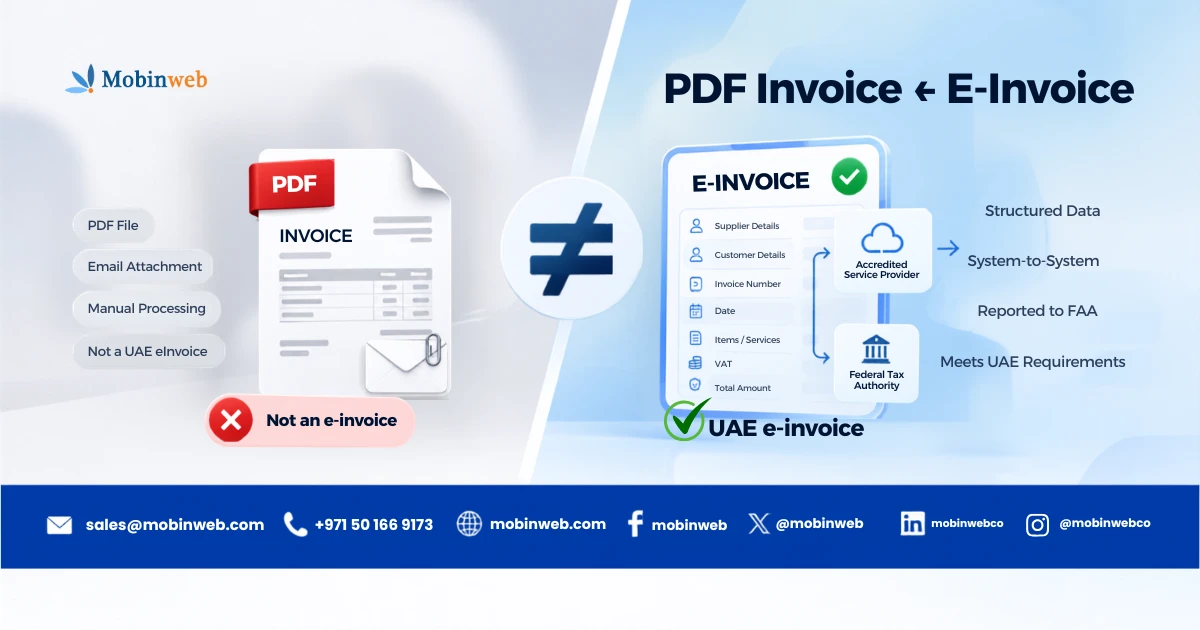
This is one of the most common misconceptions. Although a PDF invoice is delivered electronically, it is not considered a true e-Invoice under modern e-Invoicing frameworks.
A PDF is essentially a digital image or document designed for people to read. Before the invoice can be recorded in an accounting system, someone often has to download it, review it, and manually enter the information.
A compliant e-Invoice works differently. It contains structured data that software applications can interpret automatically, allowing invoices to move directly between business systems without human intervention.
| PDF Invoice | Structured e-Invoice |
|---|---|
| Human-readable | Human and machine-readable |
| Requires manual processing | Automatically processed by software |
| Sent as PDF or scanned document | Sent using structured electronic formats |
| Higher risk of manual errors | Reduces data entry mistakes |
| Limited automation | Supports end-to-end digital processing |
This distinction is important because the objective of e-Invoicing is not simply to digitize paper invoices, it is to automate the entire invoicing process.
What Is a Structured Electronic Invoice?
A structured electronic invoice contains invoice information in a standardized format that software applications can understand and process.
Instead of storing information as plain text on a document, the invoice organizes data into predefined fields such as:
- Supplier information
- Customer details
- Invoice number
- Invoice date
- VAT registration numbers
- Products or services
- Quantity
- Unit price
- Tax amounts
- Total payable
Because every invoice follows the same structure, accounting systems can validate, import, and process transactions automatically without re-entering information.
This standardization significantly improves efficiency, especially for organizations processing hundreds or thousands of invoices each month.
Why Machine-Readable Formats Matter
Machine-readable invoices allow different business systems to “speak the same language.“
For example, when a supplier issues an invoice through its ERP system, the buyer’s accounting software can automatically receive, verify, and record the transaction.
This reduces, manual data entry, typing errors, duplicate invoices, processing delays, and administrative workload. It also improves data accuracy, making financial reporting and reconciliation faster and more reliable.
For growing businesses, this automation translates into significant operational savings over time.
Moving Toward Automated Invoice Exchange
The long-term vision behind UAE e-Invoicing is seamless business-to-business communication. Rather than emailing invoices as attachments, businesses will exchange invoice data securely through standardized digital networks.
The process becomes largely automatic:
- The supplier creates an invoice within its ERP or accounting system.
- The invoice is validated against the required standards.
- It is securely transmitted through an approved network.
- The buyer’s accounting system receives and validates the invoice automatically.
- The invoice is ready for approval and payment without manual re-entry.
This streamlined approach helps businesses reduce administrative overhead while improving accuracy, compliance, and payment efficiency.
Why Is the UAE Introducing e-Invoicing?
The UAE has positioned itself as one of the world’s leading digital economies, investing heavily in technologies that simplify government services and improve the ease of doing business. The introduction of e-Invoicing is another step toward that vision.
Rather than being a standalone tax initiative, e-Invoicing forms part of a broader strategy to modernize financial transactions, encourage digital adoption, and strengthen the country’s business ecosystem.
For businesses, this represents an opportunity to move away from paper-based and manual invoicing processes toward faster, more efficient digital operations.
Supporting the UAE’s Digital Transformation
The UAE has consistently introduced initiatives that encourage businesses to embrace digital technologies. From smart government services to electronic tax filing and digital identity platforms, the country’s long-term strategy focuses on improving efficiency across both the public and private sectors.
e-Invoicing complements these initiatives by enabling businesses to exchange financial information electronically using standardized formats. As more organizations adopt digital workflows, invoicing becomes faster, more secure, and easier to integrate with modern ERP and accounting systems.
The Ministry of Finance’s Vision
The Ministry of Finance is leading the implementation of the UAE’s e-Invoicing framework as part of its broader efforts to modernize the country’s financial infrastructure.
The objective is to establish a standardized electronic invoicing ecosystem that enables businesses to exchange invoice data securely and supports greater interoperability among accounting platforms, ERP systems, and government services.
By adopting internationally recognized standards such as PEPPOL, the UAE aims to build a future-ready framework that supports domestic transactions while aligning with global best practices.
Strengthening Tax Compliance
One of the key goals of e-Invoicing is to improve the accuracy and reliability of tax reporting.
Manual invoicing processes increase the risk of:
- Missing invoices
- Duplicate records
- Data entry errors
- Inconsistent VAT calculations
- Delayed reporting
Standardized electronic invoices help reduce these issues by ensuring that invoice information is captured consistently and can be validated automatically before being processed.
This benefits both businesses and regulators by improving data quality and reducing compliance risks.
Increasing Transparency and Reducing Fraud
Traditional invoicing methods can make it difficult to detect duplicate invoices, altered documents, or incomplete records.
Because e-Invoices follow standardized formats and are exchanged through secure digital networks, businesses gain greater visibility into every transaction.
Improved traceability helps strengthen financial controls while making it easier to identify discrepancies, reduce fraudulent activities, and maintain accurate accounting records.
For organizations with high invoice volumes, this added transparency supports stronger governance and better financial oversight.
Improving Business Efficiency
While compliance is an important driver, the benefits of e-Invoicing extend well beyond regulatory requirements.
Automated invoice processing allows businesses to:
- Process invoices faster
- Reduce manual administrative work
- Improve cash flow
- Shorten payment cycles
- Minimize processing costs
- Improve supplier relationships
Instead of spending valuable time entering invoice data manually, finance teams can focus on higher-value activities such as financial planning, analysis, and business growth.
For many organizations, these operational improvements may ultimately deliver greater long-term value than compliance alone.
How UAE e-Invoicing Works
Although the underlying technology may seem complex, the e-Invoicing process is designed to simplify how businesses exchange invoice information.
Rather than emailing invoices as PDF attachments, businesses exchange structured invoice data electronically through secure, standardized networks.
A typical workflow looks like this:
Supplier ERP / Accounting System
            │
            ▼
Invoice Created
            │
            ▼
PEPPOL Access Point
            │
            ▼
Invoice Validation
            │
            ▼
Buyer's Access Point
            │
            ▼
Buyer's ERP / Accounting System
            │
            ▼
Processing & Compliance
Let’s look at each stage.
Step 1: Invoice Creation
The process begins when a supplier creates an invoice using an ERP system, accounting software, or another business application.
Instead of generating a PDF, the system prepares the invoice using a structured electronic format that complies with the applicable technical standards.
Step 2: Transmission Through a PEPPOL Access Point
The invoice is securely transmitted through a certified PEPPOL Access Point.
An Access Point acts as a secure gateway that connects businesses participating in the PEPPOL network. Rather than requiring companies to establish direct integrations with every customer or supplier, the Access Point handles the secure exchange of invoice data between systems.
This simplifies communication while maintaining interoperability across different software platforms.
Step 3: Invoice Validation
Before the invoice reaches the recipient, it is validated against the required business and technical rules.
Validation typically checks:
- Mandatory invoice fields
- Data formats
- VAT information
- Business identifiers
- Required document structure
Invoices that do not meet the required standards can be identified and corrected before entering the buyer’s accounting system, reducing processing errors later in the workflow.
Step 4: Delivery to the Buyer’s System
Once validated, the invoice is delivered electronically to the buyer through its own Access Point.
Because both parties use standardized formats, the buyer’s ERP or accounting software can automatically recognize and process the invoice without requiring manual data entry.
This significantly reduces invoice processing time while improving accuracy.
Step 5: Processing and Compliance
After receipt, the buyer can review, approve, and process the invoice within its existing financial systems.
Because invoice data has already been structured and validated, downstream activities such as approval workflows, accounting entries, payment processing, and regulatory reporting become faster and more efficient.
As organizations adopt integrated ERP and accounting solutions, much of this workflow can operate with minimal manual intervention.
What Is PEPPOL?
One of the terms businesses will encounter most frequently during the UAE’s e-Invoicing rollout is PEPPOL.
Although the name sounds technical, the concept is relatively straightforward. PEPPOL is an international framework that enables businesses and government organizations to exchange electronic business documents using a common set of technical standards.
Instead of every software provider building separate connections for every customer or supplier, PEPPOL creates a standardized network where different systems can communicate seamlessly.
Think of it as a universal delivery network for electronic business documents.
Who Manages PEPPOL?
PEPPOL is governed by OpenPeppol, an international non-profit organization responsible for maintaining the network’s specifications, technical standards, and governance framework.
Its role is to ensure that organizations participating in the network adhere to consistent rules for securely and reliably exchanging electronic documents.
Because PEPPOL is based on internationally recognized standards, it supports interoperability across multiple countries and software platforms.
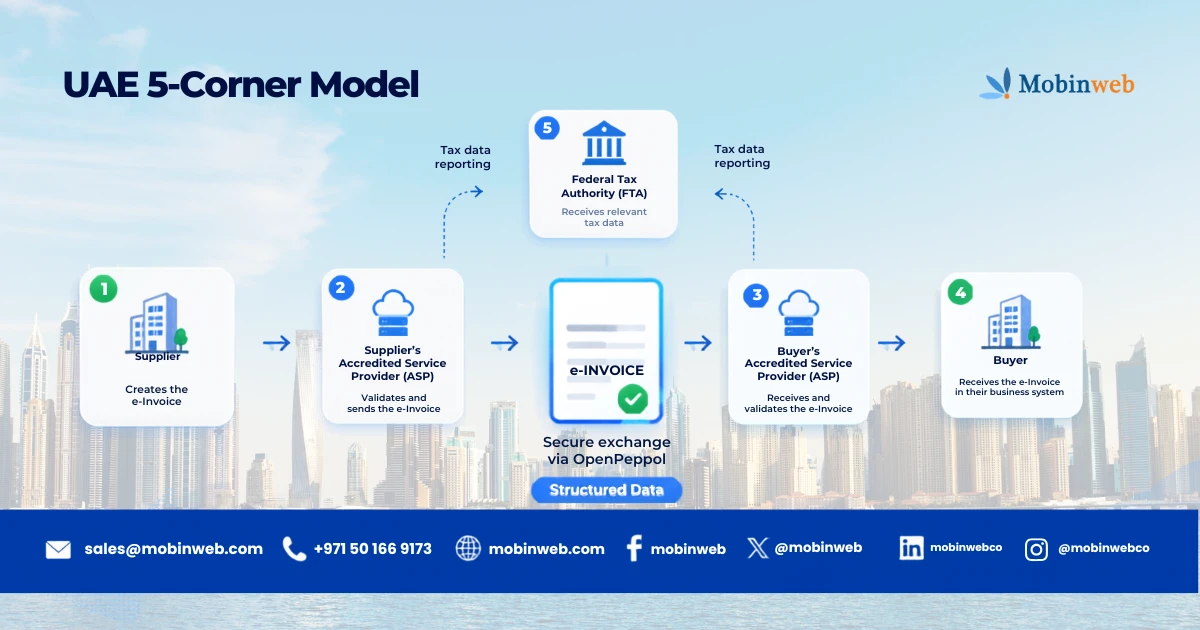
Understanding the Four-Corner Model
One of PEPPOL’s biggest strengths is its Four-Corner Model.
Rather than requiring every buyer and supplier to build direct connections with each other, both parties communicate through certified Access Points.
The model consists of:
Corner 1 – Supplier
Creates the invoice using an ERP or accounting system.
Corner 2 – Supplier Access Point
Securely sends the invoice into the PEPPOL network.
Corner 3 – Buyer Access Point
Receives the invoice and verifies it.
Corner 4 – Buyer
Receives the invoice directly within its accounting or ERP system.
This architecture allows organizations using different software solutions to exchange invoices without worrying about system compatibility.
What Is a PEPPOL Access Point?
A PEPPOL Access Point is a certified service provider that connects businesses to the PEPPOL network.
Instead of each company developing complex integrations with every trading partner, businesses connect to a single Access Point, which handles the secure transmission of electronic documents.
This simplifies implementation while ensuring that all communications follow the same international standards.
Benefits of PEPPOL for Businesses
For UAE businesses, adopting PEPPOL offers benefits that extend beyond compliance.
These include:
- Standardized invoice exchange across different software platforms
- Faster invoice delivery and processing
- Reduced manual data entry
- Improved accuracy and fewer processing errors
- Better interoperability between suppliers and customers
- Enhanced security and traceability
- Easier integration with ERP and accounting systems
- Support for future digital transformation initiatives
As e-Invoicing adoption expands, businesses that implement PEPPOL-compatible systems early will be better prepared to collaborate with customers, suppliers, and government entities in an increasingly digital business environment.
Understanding PINT AE
As businesses begin preparing for UAE e-Invoicing, they will encounter another important term alongside PEPPOL: PINT AE.
Although both are closely related, they serve different purposes within the e-Invoicing ecosystem. Understanding the distinction will help businesses choose the right software, prepare their systems correctly, and ensure future compliance.
What Is PINT?
PINT stands for PEPPOL International Invoice. It is a standardized invoice specification developed within the PEPPOL framework that enables businesses in different countries to exchange electronic invoices using a common structure.
Rather than each country creating entirely different invoice formats, PINT provides a consistent foundation that promotes interoperability while allowing local adaptations where necessary. Think of PINT as a global template for electronic invoices.
What Is PINT AE?
PINT AE is the UAE’s localized implementation of the PEPPOL International Invoice standard. While it follows the core PEPPOL framework, it incorporates specific business rules, tax requirements, and technical specifications needed to support the UAE’s regulatory environment.
This localized approach ensures that invoices exchanged within the UAE contain the information required by local authorities while remaining compatible with international PEPPOL standards.
For businesses, this means software solutions must support not only PEPPOL connectivity but also the UAE-specific invoice requirements defined under PINT AE.
Why Did the UAE Develop PINT AE?
The UAE’s objective is to create an e-Invoicing framework that balances international interoperability with local compliance.
By adopting PINT AE, the country can:
- Align with internationally recognized PEPPOL standards.
- Support seamless invoice exchange between businesses.
- Accommodate UAE-specific VAT and regulatory requirements.
- Reduce implementation complexity for software providers.
- Enable future cross-border interoperability.
Instead of creating an entirely new e-Invoicing standard, the UAE has chosen to build upon an established international framework while tailoring it to local business needs.
How Is PINT AE Different from Standard PEPPOL?
Although PINT AE is based on PEPPOL, it includes additional requirements specific to the UAE.
These may include localized business rules, invoice validation requirements, tax information, and mandatory data elements that support compliance with the UAE’s e-Invoicing framework.
In simple terms:
- PEPPOL defines how invoices are securely exchanged.
- PINT AE defines what information a UAE-compliant invoice must contain.
Businesses should ensure that their ERP, accounting software, or e-Invoicing solution supports both the PEPPOL network and the UAE’s PINT AE specifications as implementation progresses.
What Information Must a UAE e-Invoice Contain?
While the detailed technical specifications continue to evolve, structured electronic invoices are generally expected to include standardized information such as:
- Supplier details
- Customer information
- VAT registration numbers
- Invoice number
- Invoice date
- Product or service descriptions
- Quantities
- Unit prices
- VAT calculations
- Total invoice amount
- Currency
- Payment terms
Using standardized fields ensures invoices can be validated, exchanged, and processed automatically between different business systems.
As official implementation guidance develops, businesses should continue monitoring updates from the UAE Ministry of Finance and the Federal Tax Authority (FTA) to ensure their systems remain compliant.
Who Must Comply with UAE e-Invoicing?
One of the most common questions businesses ask is whether the UAE’s e-Invoicing framework applies to them.
The answer depends on the final implementation phases announced by the government. While the framework is expected to be introduced gradually, businesses should begin preparing well before mandatory deadlines are announced.
Organizations that already rely on digital accounting or ERP systems are generally in a stronger position to adapt, while businesses with manual invoicing processes may require more preparation.
VAT-Registered Businesses
VAT-registered businesses are expected to be among the primary organizations affected by the UAE’s e-Invoicing initiative.
Since VAT compliance already requires accurate invoice documentation and reporting, structured electronic invoicing naturally complements the existing tax framework.
Businesses should review their accounting systems now to determine whether they can support future e-Invoicing requirements.
Government Suppliers
Organizations supplying products or services to government entities should closely monitor developments.
Many countries begin e-Invoicing implementation by introducing electronic invoicing requirements for government procurement before expanding to business-to-business transactions.
Businesses working with government agencies may therefore need to adopt compliant invoicing systems earlier than others.
Small and Medium-Sized Enterprises (SMEs)
Small businesses often assume that digital compliance initiatives only affect large corporations.
However, SMEs should not overlook e-Invoicing preparation.
Modern cloud accounting platforms already include many automation capabilities that can simplify future compliance while improving invoice accuracy, payment processing, and financial reporting.
Early adoption can also reduce the disruption associated with future regulatory changes.
Enterprise Organizations
Large organizations processing thousands of invoices every month stand to benefit significantly from automation.
Enterprise businesses typically operate multiple ERP systems, procurement platforms, suppliers, and finance teams.
Implementing structured e-Invoicing can reduce manual processing, improve workflow efficiency, strengthen financial controls, and support regulatory compliance across the organization.
A Phased Implementation Is Expected
As with many large-scale regulatory initiatives, the UAE’s e-Invoicing rollout is expected to occur in phases.
Different categories of businesses may become subject to compliance requirements at different times depending on official implementation schedules.
Businesses should monitor announcements from the Ministry of Finance and the Federal Tax Authority for confirmed timelines and sector-specific guidance.
Rather than waiting until implementation becomes mandatory, organizations should use this period to evaluate their existing systems and begin planning their transition.
UAE e-Invoicing Timeline
The UAE’s e-Invoicing initiative is being introduced in phases to give businesses, software providers, and service providers sufficient time to prepare.
While some milestones have already been announced, future implementation dates may continue to evolve as the framework matures.
Below is a simplified overview of the rollout.
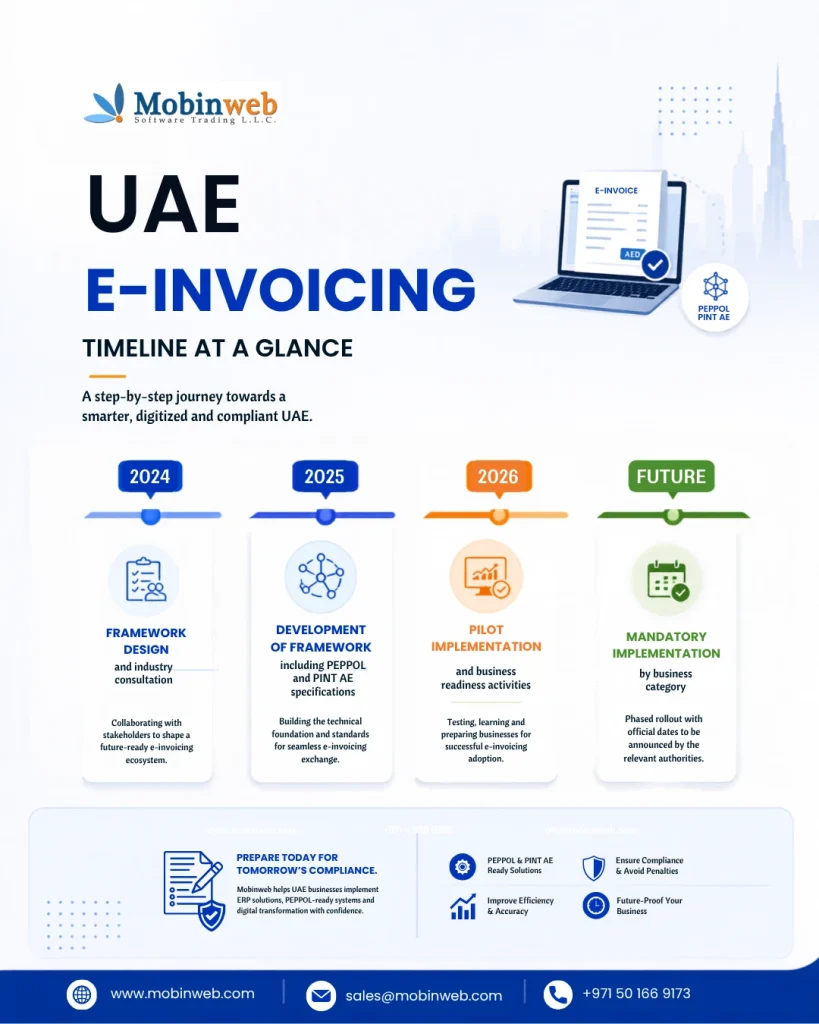
Important: Businesses should always refer to official announcements from the UAE Ministry of Finance and the Federal Tax Authority for the latest implementation schedules and compliance deadlines.
Benefits of UAE e-Invoicing
Although compliance is the primary driver for many organizations, the advantages of e-Invoicing extend well beyond meeting regulatory requirements.
Businesses that modernize their invoicing processes often experience improvements across finance, operations, and customer service.
Faster Payments
Manual invoice processing often creates delays between issuing an invoice and receiving payment.
Electronic invoices move directly between business systems, reducing processing time and enabling invoices to reach customers more quickly.
Faster approvals often translate into faster payments and healthier cash flow.
Reduced Errors
Manual data entry increases the likelihood of:
- Incorrect invoice numbers
- Duplicate invoices
- VAT calculation errors
- Missing information
- Typographical mistakes
Structured electronic invoices minimize these risks by validating information before invoices are exchanged.
Better Cash Flow
Efficient invoicing directly improves cash flow.
When invoices are delivered, approved, and processed more quickly, businesses spend less time chasing outstanding payments and more time focusing on growth.
Less Manual Work
Finance teams frequently spend hours entering invoice information manually. Automated invoice exchange eliminates repetitive administrative tasks, allowing staff to focus on higher-value activities such as financial analysis, forecasting, and customer support.
Improved Compliance
Standardized invoice formats make it easier to maintain accurate financial records while supporting VAT reporting and future regulatory requirements.
Businesses can also reduce the risk of missing mandatory information or submitting inconsistent records.
Lower Operating Costs
Reducing paper, printing, postage, manual processing, and invoice error correction can significantly lower administrative expenses.
For organizations handling high invoice volumes, these savings can become substantial over time.
Real-Time Financial Visibility
Because invoice data flows directly into accounting and ERP systems, businesses gain faster access to financial information.
This enables finance teams to:
- Monitor outstanding invoices
- Track payments
- Improve forecasting
- Generate reports more quickly
- Make better business decisions
Real-time visibility is one of the most valuable long-term benefits of digital invoicing.
How Businesses Can Prepare for UAE e-Invoicing
Although implementation may be mandatory in phases, businesses should begin preparing now. Early planning reduces implementation risks and gives organizations sufficient time to upgrade systems, train employees, and refine internal processes.
Assess Your Current Processes
Start by reviewing how invoices are currently created, approved, sent, and stored. Identify manual steps that could become bottlenecks during digital transformation. Understanding your current workflow provides the foundation for a successful transition.
Review Your ERP System
Determine whether your existing ERP platform supports electronic invoicing and future PEPPOL connectivity. If your ERP system is outdated or highly customized, additional upgrades or integrations may be required.
Evaluate Your Accounting Software
Cloud-based accounting solutions are generally better positioned to support future e-Invoicing requirements.
Review your software vendor’s roadmap and confirm whether future compliance features are planned.
Identify Integration Requirements
Many businesses use multiple systems for finance, procurement, inventory, CRM, and payroll.
Understanding how these systems exchange information today will help simplify future integration with e-Invoicing platforms.
Train Finance and Operations Teams
Technology alone is not enough. Employees responsible for invoicing, accounting, procurement, and finance should understand the new processes, responsibilities, and compliance requirements before implementation begins.
Choose the Right Technology Partner
Working with an experienced technology partner can simplify the transition.
A knowledgeable implementation partner can assess existing systems, recommend appropriate software, manage integrations, and help ensure the solution aligns with evolving compliance requirements.
Test Before Going Live
Before using e-Invoicing in production, businesses should validate:
- Invoice generation
- Data accuracy
- System integrations
- Approval workflows
- Accounting entries
- Exception handling
Testing helps identify issues early and reduces operational disruption once electronic invoicing becomes part of everyday business processes.
Choosing the Right Business Software
The success of your e-Invoicing implementation depends not only on compliance but also on selecting software that supports your broader business objectives. When evaluating solutions, consider more than just invoice generation.
A modern platform should integrate finance, operations, reporting, and future digital initiatives. Businesses should look for solutions that offer:
- ERP capabilities for enterprise resource planning
- Accounting and financial management
- Cloud accessibility
- PEPPOL compatibility
- Integration with existing business applications
- Scalability as the organization grows
Whether you’re implementing a complete ERP platform, upgrading your accounting software, or modernizing your business processes through solutions such as QBM, choosing software with strong integration capabilities will make future compliance significantly easier.
Rather than viewing e-Invoicing as a standalone project, organizations should treat it as an opportunity to modernize their entire financial ecosystem.
Common Challenges Businesses May Face
Transitioning to electronic invoicing is not only a technology project, it also involves people, processes, and organizational change.
Some of the most common challenges include:
Legacy Systems
Older accounting platforms may lack support for modern e-Invoicing standards or require costly upgrades.
Manual Workflows
Organizations that still rely heavily on spreadsheets, email approvals, or paper documentation may need to redesign their internal processes.
System Integration
Connecting ERP systems, accounting software, procurement platforms, and external service providers can require careful planning.
Data Quality
Incomplete customer records, inconsistent VAT information, and duplicate data can create implementation issues.
Employee Training
Staff need time to understand new workflows and adapt to digital processes.
Keeping Up With Regulatory Changes
As the UAE’s e-Invoicing framework continues to develop, businesses should monitor official guidance and ensure their systems remain aligned with evolving requirements.
Frequently Asked Questions
What is UAE e-Invoicing?
UAE e-Invoicing is a standardized framework for exchanging structured electronic invoices between businesses using machine-readable formats instead of traditional PDF or paper invoices.
Who needs to comply with UAE e-Invoicing?
Implementation is expected to occur in phases. VAT-registered businesses, government suppliers, SMEs, and enterprise organizations should monitor official announcements to understand when compliance requirements will apply to them.
Is a PDF invoice considered an e-Invoice?
No. A PDF is electronically delivered but is not a structured electronic invoice that can be automatically processed between business systems.
What is PEPPOL?
PEPPOL is an international network and set of standards that enables businesses to exchange electronic invoices securely and consistently.
What is PINT AE?
PINT AE is the UAE’s localized implementation of the PEPPOL International Invoice standard, incorporating country-specific business rules and technical requirements.
When will UAE e-Invoicing become mandatory?
The UAE is currently implementing its national e-Invoicing framework through a phased approach. During 2026, the focus is on pilot activities and business readiness, with mandatory implementation expected to be introduced progressively for different categories of businesses. Companies should follow official announcements from the Ministry of Finance (MoF) and the Federal Tax Authority (FTA) for confirmed implementation dates.
How should businesses prepare?
Review your invoicing processes, assess your ERP and accounting software, identify integration needs, train employees, and begin planning your transition well before mandatory implementation.
Conclusion
The introduction of e-Invoicing marks another significant milestone in the UAE’s digital transformation journey. While compliance is an important driver, the real value lies in creating faster, more efficient, and more connected financial operations.
Businesses that begin preparing today will be better equipped to manage future regulatory requirements while improving accuracy, reducing manual work, and gaining greater visibility into their financial processes.
Rather than viewing e-Invoicing as a compliance burden, organizations should see it as an opportunity to modernize their technology, streamline operations, and build a stronger foundation for long-term growth.
Prepare Your Business for UAE e-Invoicing
Transitioning to e-Invoicing involves more than meeting regulatory requirements; it requires the right technology, well-defined processes, and expert guidance.
At Mobinweb, we help businesses modernize their financial operations through ERP implementation, accounting software, digital workflow automation, and system integration. Our solutions are designed to support evolving compliance requirements while improving efficiency across your organization.
Whether you’re evaluating your existing systems or planning your e-Invoicing roadmap, our team can help you prepare with confidence.
Ready to future-proof your business? Talk to a Mobinweb expert today.