Are PDF Invoices Considered E-Invoices in the UAE?
No. A PDF invoice is not considered an e-Invoice under the UAE e-Invoicing system.
The UAE Ministry of Finance defines an e-Invoice as structured invoice data that is issued, exchanged, and reported electronically through the e-Invoicing system. PDF files, Word documents, images, scanned invoices, and invoices sent by email are considered unstructured formats and are not e-Invoices.
So, simply creating an invoice as a PDF and emailing it does not make it a UAE e-Invoice.
What Is a PDF Invoice?
A PDF invoice is an electronic version of a document. For example, a business might:
- Create an invoice using accounting software.
- Save it as a PDF.
- Email the PDF to the customer.
The invoice may contain all the usual information, such as:
- Supplier details
- Customer details
- Invoice number
- Date
- Products or services
- VAT
- Total amount
However, the invoice is still a PDF document, rather than structured invoice data that can be automatically processed through the UAE e-Invoicing system.
What Is a UAE E-Invoice?
A UAE e-Invoice is different. It is created and exchanged as structured digital data, allowing systems to read and process the information automatically. It is also reported electronically to the Federal Tax Authority (FTA) through the UAE e-Invoicing framework.
The UAE framework uses accredited service providers to validate and exchange e-Invoice data between businesses.
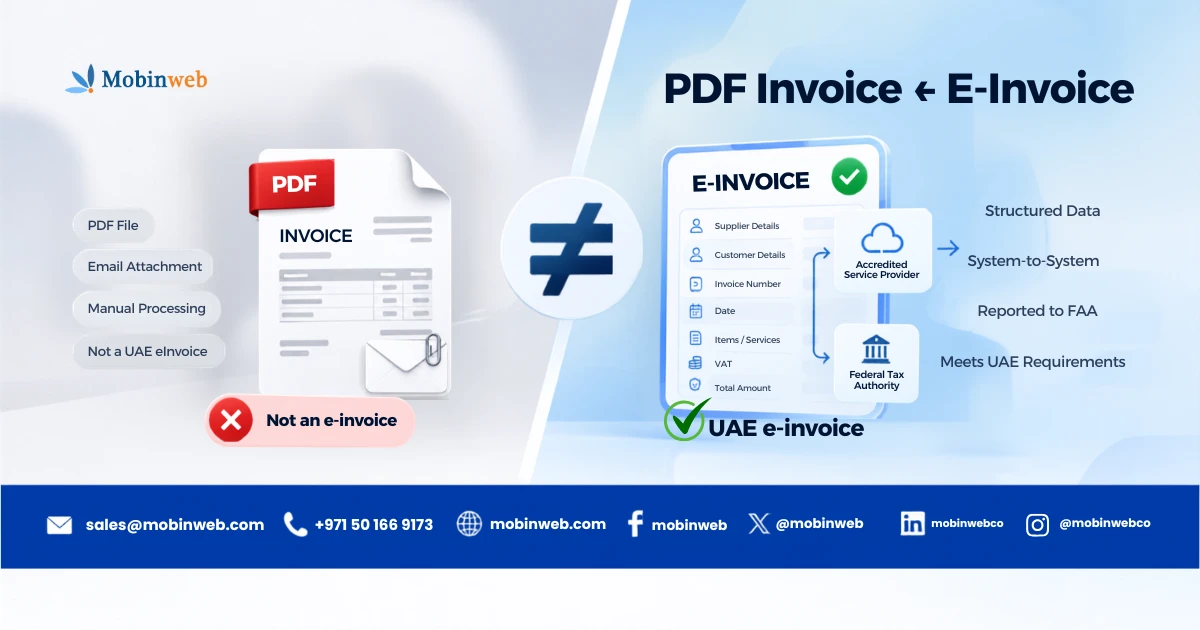
In simple terms, a PDF invoice is created by the business, saved as a PDF file, and usually emailed to the customer to open and read.
An e-Invoice, on the other hand, is created as structured invoice data within the business’s system. The data is then sent through an accredited service provider and exchanged with the buyer’s system. This allows the invoice information to be processed and exchanged automatically.
PDF Invoice vs E-Invoice: What’s the Difference?
| PDF Invoice | UAE E-Invoice |
|---|---|
| Document format | Structured digital data |
| Usually viewed manually | Designed for automatic processing |
| Can be emailed as an attachment | Exchanged through the e-Invoicing system |
| Not considered a UAE e-Invoice | Meets the UAE e-Invoice framework |
| Information may need to be entered manually | Data can be processed by systems |
The key difference is not simply whether the invoice is digital. It is how the invoice data is structured, exchanged, processed, and reported.
Why Doesn’t a PDF Count as an E-Invoice?
A PDF is mainly designed for people to read. A structured e-Invoice is designed so that business systems can read and process the invoice data.
For example, a PDF might show:
Invoice number: INV-1025
Customer: ABC Trading
Total: AED 10,500
A person can read this information easily. But an e-Invoice contains structured data that allows compatible systems to identify and process fields such as the invoice number, buyer, seller, tax information, and amounts.
The UAE Ministry of Finance specifically states that PDFs, Word documents, images, scanned copies, and emails are not e-Invoices.
How Does UAE E-Invoicing Work?
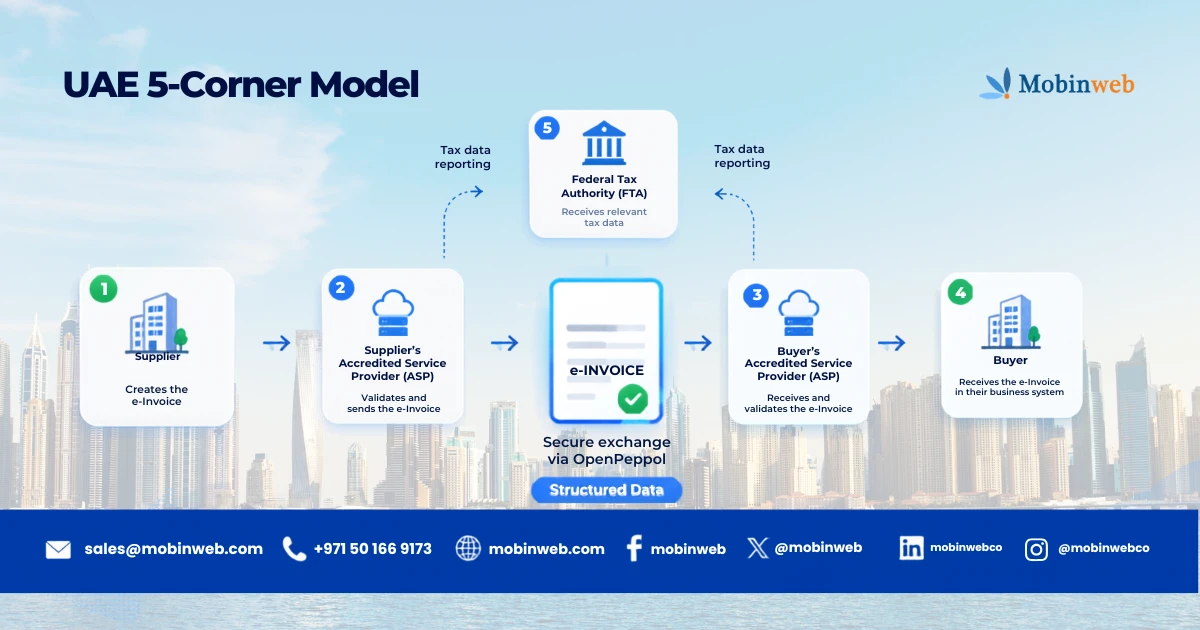
The UAE’s e-Invoicing framework uses accredited service providers to facilitate the exchange of structured invoice data.
1. Supplier creates the invoice
The supplier’s business system provides the required invoice data.
2. Accredited Service Provider validates the data
The service provider checks the invoice data and prepares it according to the UAE requirements.
3. Invoice data is exchanged
The e-Invoice is transmitted to the buyer’s accredited service provider through the approved network.
4. Buyer receives the invoice
The buyer receives the invoice data in a format its business system can process.
5. Reporting Tax data
Relevant tax data also goes through the UAE e-Invoicing framework. This is why e-Invoicing is more than simply sending an invoice electronically.
Does Sending a PDF by Email Make It an E-Invoice?
No.
Sending a PDF invoice by email is still sending an unstructured invoice document.
The UAE Federal Tax Authority specifically confirms that PDF, Word, image, scanned, and email-based invoice formats are not e-Invoices. Think of it this way: Digital invoice ≠ e-Invoice. An invoice can be digital without being a compliant e-Invoice under the UAE system.
What Do UAE Businesses Need to Prepare?
Businesses should not wait until implementation requirements become urgent. Preparation can start with understanding:
1. Current invoicing process
Identify how invoices are currently:
- Created
- Approved
- Sent
- Received
- Stored
- Reported
2. Accounting and ERP systems
Check whether your existing systems can support the data and integration requirements needed for e-Invoicing.
3. Invoice data
Review the information currently included on your invoices and compare it with the UAE’s mandatory e-Invoice requirements.
The Ministry of Finance has published a specific list of mandatory fields for UAE e-Invoices.
4. Service provider options
Businesses should understand how accredited e-Invoicing service providers will connect with their existing systems.
The UAE Ministry of Finance provides information on accredited service providers through its e-Invoicing program.
What Should SMEs Do Now?
For many businesses, the first step is not replacing everything immediately. Start by understanding your current systems and processes.
A simple preparation checklist includes:
- Assess current invoicing process
- Check accounting or ERP system
- Review your invoice data
- Understand the UAE e-Invoicing requirements
- Evaluate integration needs
- Research accredited service providers
- Plan your implementation before your required deadline
The UAE Ministry of Finance has published official guidelines covering the framework, scope, implementation approach, business readiness, and other requirements.
FAQs
Is a PDF invoice an e-Invoice in the UAE?
No. The UAE Ministry of Finance states that PDF invoices and other unstructured formats are not e-Invoices.
Can I still use PDF invoices?
A PDF is still a useful document for viewing or sharing invoice information, but it is not the same as a structured e-Invoice under the UAE e-Invoicing framework.
What makes an invoice an e-Invoice?
A UAE e-Invoice is structured invoice data that is issued and exchanged electronically through the e-Invoicing system and reported electronically to the FTA.
Is an invoice sent by email an e-Invoice?
No, if it is simply a PDF or other unstructured document attached to an email. The FTA explicitly excludes these formats from the definition of an e-Invoice.
Do businesses need special software for e-Invoicing?
Businesses need systems and/or integrations that support UAE e-Invoicing requirements. Accredited service providers play a central role in validating and exchanging e-Invoice data.
Where can I find the official UAE e-Invoicing information?
The UAE Ministry of Finance is the official source for information about the national e-Invoicing program.
How Mobinweb Can Help
Moving from traditional invoices to e-Invoicing involves more than changing an invoice format. Businesses may need to review their accounting systems, ERP, invoice workflows, integrations, and data processes to prepare for the new requirements.
Mobinweb can help businesses assess their current technology environment and plan the systems and integrations needed for a smoother transition to UAE e-Invoicing.
Need help preparing your business for UAE e-Invoicing? Contact Mobinweb to discuss your requirements.