What Is the UAE 5-Corner Model?
The UAE 5-Corner Model is a framework for exchanging and reporting e-Invoices electronically.
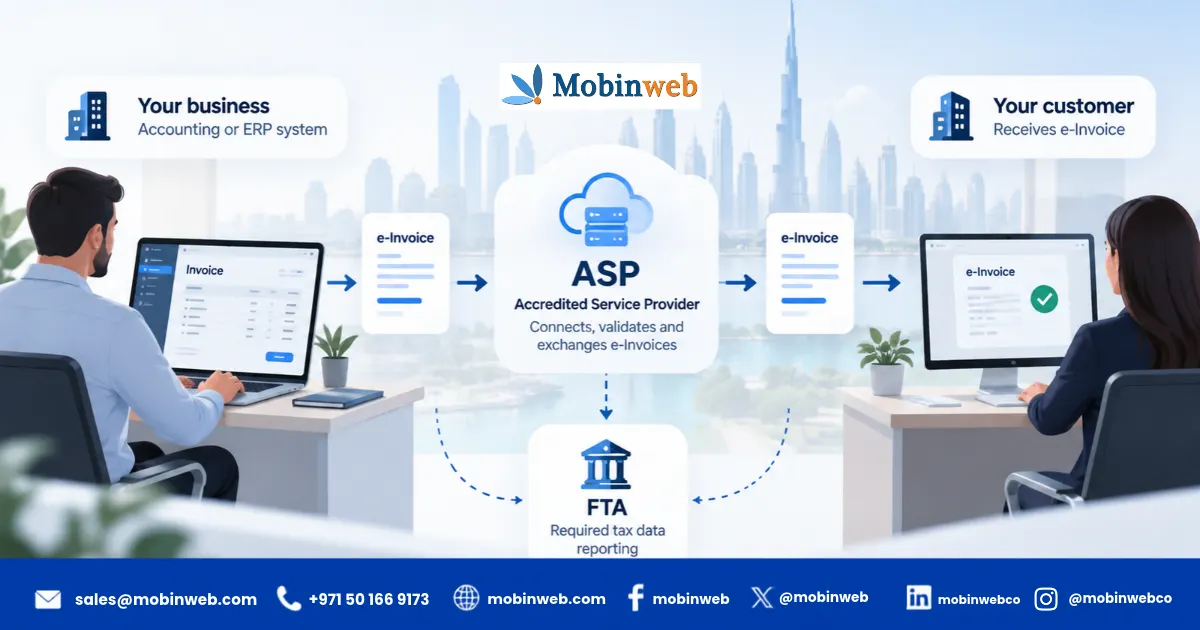
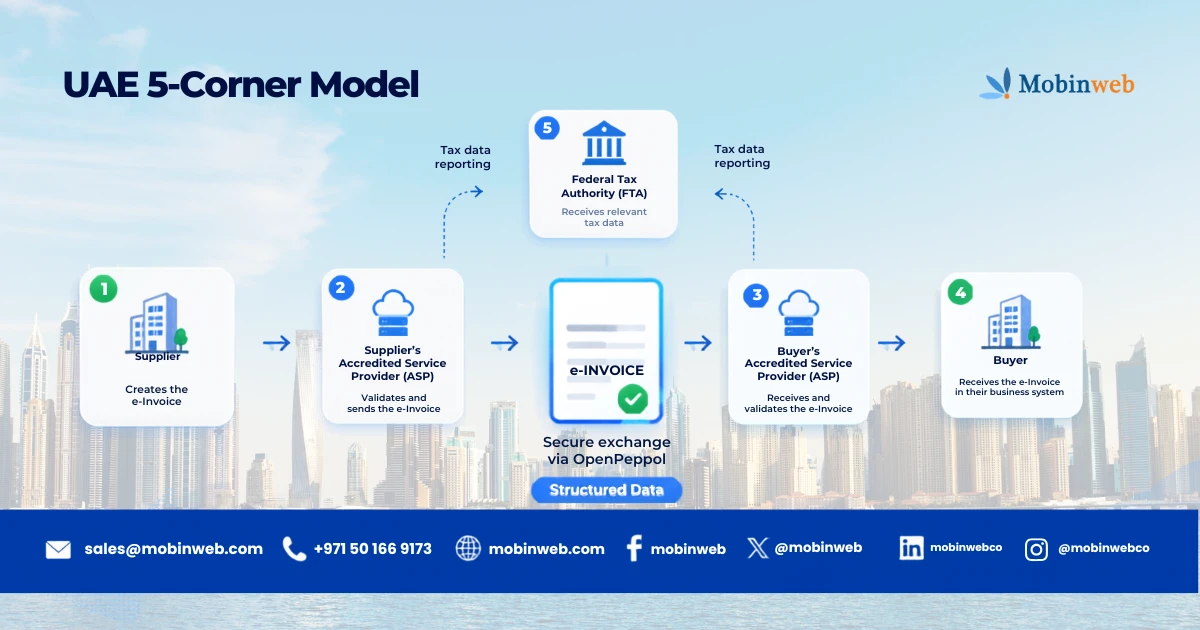
It connects the supplier, the supplier’s Accredited Service Provider (ASP), the buyer’s ASP, the buyer, and the Federal Tax Authority (FTA). The model is part of the UAE’s decentralized e-Invoicing framework and uses the OpenPeppol standard to support secure and structured invoice exchange.
In simple terms, the model makes sure an e-Invoice can move from the seller to the buyer while the required tax data is also reported to the FTA.
What Are the 5 Corners?
The five corners are:
Corner 1: Supplier
The supplier is the business issuing the e-Invoice. The supplier creates the invoice data through its accounting, ERP, or other business software and sends it to its Accredited Service Provider.
Corner 2: Supplier’s Accredited Service Provider
The supplier’s Accredited Service Provider (ASP) receives and validates the e-Invoice data. It then transmits the e-Invoice to the buyer’s Accredited Service Provider in the required format and over the required network.
The ASP also handles relevant reporting and communication between the different parts of the system.
Corner 3: Buyer’s Accredited Service Provider
The buyer’s ASP receives the e-Invoice from the supplier’s ASP. It validates the invoice and delivers the invoice data to the buyer’s business system in an agreed format.
Corner 4: Buyer
The buyer receives the e-Invoice through its Accredited Service Provider. The buyer can then receive the invoice data directly into its business software for processing.
This means the buyer does not need to manually download and enter information from a PDF invoice.
Corner 5: Federal Tax Authority
The Federal Tax Authority (FTA) is the fifth corner. Relevant tax data is reported electronically through the e-Invoicing framework. The FTA supports tax reporting and compliance within the system.
How Does the 5-Corner Model Work?
The process can be simplified into five main steps:
1. The supplier creates the e-Invoice
The supplier creates the invoice through its business or accounting software.
2. The supplier’s ASP validates and sends it
The supplier’s ASP checks the invoice data and sends it to the buyer’s ASP.
3. The buyer’s ASP receives and validates it
The buyer’s ASP checks the invoice and prepares it for delivery to the buyer.
4. The buyer receives the e-Invoice
The invoice data is delivered to the buyer’s business software.
5. Tax data is reported to the FTA
The required tax data is reported electronically through the e-Invoicing framework.
The UAE Ministry of Finance describes this as a Decentralized Continuous Transaction Control and Exchange (DCTCE) model.
Why Is It Called a 5-Corner Model?
The name comes from the five participants in the framework:
Supplier → Supplier ASP → Buyer ASP → Buyer, with the FTA receiving the relevant tax data as the fifth corner.
The ASPs handle secure invoice exchange and validation, while the FTA receives the required tax data.
What Is the Difference Between the 4-Corner and 5-Corner Models?
You may also see the term 4-Corner Model when researching UAE e-Invoicing. There is a simple reason for this.
The four corners represent the parties involved in exchanging the invoice:
- Supplier
- Supplier’s ASP
- Buyer’s ASP
- Buyer
The fifth corner is the FTA, which receives the relevant tax data. The Ministry of Finance first activated the 4-Corner model for electronic invoice exchange and then introduced the fifth corner for tax reporting as part of the wider 5-Corner framework.
So, when you see both terms, they are not necessarily describing two completely different systems.
4-Corner = invoice exchange
5-Corner = invoice exchange + tax reporting to the FTA
What Is the Role of Accredited Service Providers?
Accredited Service Providers are an important part of the UAE e-Invoicing system.
They help businesses connect to the e-Invoicing network and handle activities such as validating and securely transmitting e-Invoice data.
Businesses subject to the system will need to work with an Accredited Service Provider as part of their e-Invoicing setup. The Ministry of Finance maintains information on approved and accredited providers.
Businesses should therefore consider provider selection as part of their e-Invoicing preparation.
What Does the 5-Corner Model Mean for Businesses?
For businesses, the 5-Corner Model means e-Invoicing is more than simply changing an invoice format. Businesses need to consider how their:
- Accounting software
- ERP system
- Invoice data
- Internal workflows
- Accredited Service Provider
- Customer and supplier connections
will work together. The goal is to make invoice exchange and tax reporting more automated, structured, and secure.
Do Businesses Send E-Invoices Directly to the FTA?
Not in the same way they would send an invoice to a customer.
The supplier and buyer exchange the e-Invoice through their Accredited Service Providers. The relevant tax data is then reported to the FTA through the e-Invoicing framework.
This is one of the key differences between the UAE’s 5-Corner Model and a system where businesses would simply upload every invoice directly to a government portal.
What Should Businesses Do Now?
Businesses should start by understanding how their current invoicing systems work.
A useful starting point is to:
Review your current invoicing process. Understand how invoices are created, approved, sent, received, and stored.
Check your accounting or ERP system. Determine whether your current software can support the data and integration requirements of e-Invoicing.
Understand the 5-Corner Model. Knowing how the supplier, ASPs, buyer, and FTA interact will make implementation easier to plan.
Evaluate Accredited Service Providers. Consider which provider can integrate effectively with your existing systems and business processes.
Plan your implementation. Businesses should prepare their systems and processes ahead of their applicable implementation requirements.
The UAE has adopted a phased rollout, with implementation dates varying by business and circumstances.
FAQs
What is the UAE 5-Corner Model?
The UAE 5-Corner Model is the country’s framework for exchanging and reporting e-Invoices. It connects the supplier, the supplier’s ASP, the buyer’s ASP, the buyer, and the FTA.
What are the five corners?
The five corners are:
- Supplier
- Supplier’s Accredited Service Provider
- Buyer’s Accredited Service Provider
- Buyer
- Federal Tax Authority
What is the difference between the 4-Corner and 5-Corner Models?
The 4-Corner Model focuses on exchanging e-Invoices between the supplier and buyer through their ASPs. The 5-Corner Model adds the FTA as the fifth corner for tax data reporting.
What is an Accredited Service Provider?
An Accredited Service Provider is a service provider approved under the UAE e-Invoicing framework to provide electronic invoicing services and support the exchange of e-Invoice data.
Does the 5-Corner Model use Peppol?
Yes. The UAE e-Invoicing framework is based on the OpenPeppol standard to support interoperability and electronic invoice exchange.
Do businesses need to change their accounting systems?
Businesses may need to update or integrate their existing accounting or ERP systems to support UAE e-Invoicing requirements and connect with their chosen Accredited Service Provider.
How Mobinweb Can Help
Moving to UAE e-Invoicing requires businesses to look beyond the invoice itself.
Your accounting software, ERP, invoice workflows, data, and integrations must work together as part of the new process. Mobinweb can help businesses assess their existing technology environment and plan the integrations and systems needed to prepare for UAE e-Invoicing.
Need help preparing your business for UAE e-Invoicing? Contact Mobinweb to discuss your requirements.